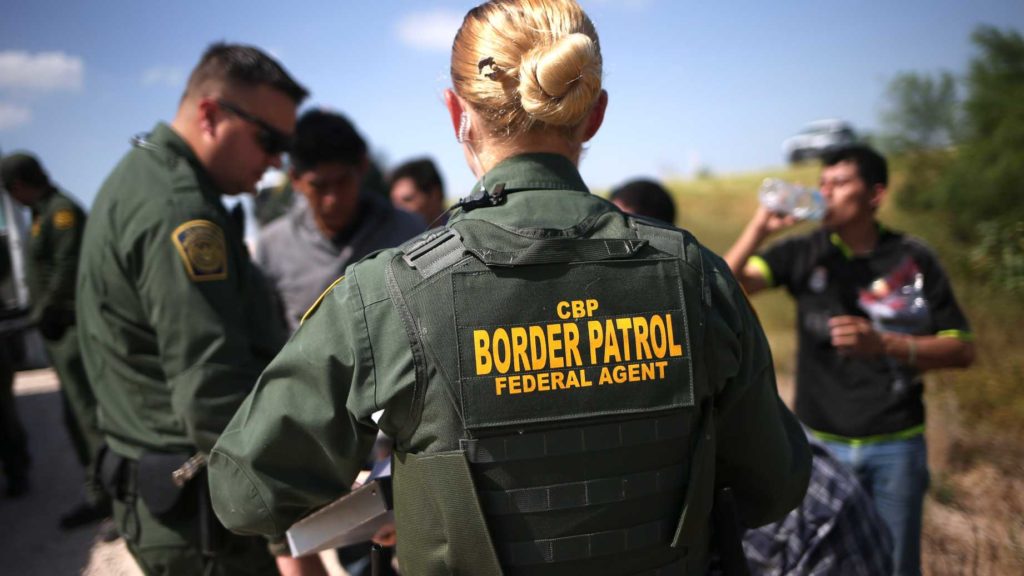
Until Trump’s arrival, there was increasingly no border at all. Fifty-million foreign-born resided, both legally and illegally, in the United States. Nearly a million annually walked northward across the border with ease and without legal sanction or invitation. To object to illegal immigration and decry its deleterious effects on the entry-level wages of our working poor, on the social safety net of the American needy, and on the sanctity of the law was to be smeared as racist, xenophobic, and nativist.
Against all the money and clout of America’s revolutionary forces, the counterrevolutionary Trump had only one asset, the proverbial people.
Victor Davis Hanson
Amgreatness.com
November 1, 2020
Until Donald Trump’s arrival, the globalist revolution was almost solidified and institutionalized—with the United States increasingly its greatest and most “woke” advocate. We know its bipartisan establishment contours.
China would inherit the world in 20 or 30 years. The self-appointed task of American elites—many of whom had already been enriched and compromised by Chinese partners and joint ventures—was to facilitate this all-in-the-family transition in the manner of the imperial British hand-off of hegemony to the United States in the late 1940s.
Our best and brightest like the Biden family, Senator Dianne Feinstein (D-Calif.), Bill Gates, or Mark Zuckerberg would enlighten us about the “real” China, so we yokels would not fall into Neanderthal bitterness as they managed our foreordained decline.
We would usher China into “the world community”—grimacing at, but overlooking the destruction it wrought on the global commercial order and the American interior.
We would politely forget about Hong Kong, Taiwan, Tibet, and the Uyghurs. Hollywood would nod as it put out more lucrative comic-book and cartoonish films for the Chinese markets, albeit with mandated lighter-skinned actors.
The NBA would nod twice and trash a democratic United States, while praising genocidal China—becoming richer and more esteemed abroad to make up for becoming boring and poorer at home. The universities would nod three times, and see a crime not in Chinese espionage and security breaches, but in the reporting of them as crimes.
So our revolutionary role would be to play stuffy and snooty Athenian philosophers to the new muscular Roman legions of China.
Given our elites’ superior morality, genius, and sense of self, we would gently chide and cajole our Chinese masters into becoming enlightened world overseers and democrats—all the easier, the richer and more affluent Chinese became.
For now, Trump has stopped that revolution.
Internal Counterrevolutions
Until Trump’s arrival, Big Tech was three-quarters home on the road to Nineteen Eighty-Four. Five or six companies monopolized most American—and indeed the world’s—access and use of the internet. In cynical fashion, Silicon Valley grandees patronized naïve conservatives that they were the supposed embodiment of Milton Friedman libertarianism and 19th century robber baron daring. Yet to their leftist kindred, the moguls of Menlo Park simultaneously whispered, “Don’t worry about such necessary disinformation: we will enrich only your candidates, only your agendas, only your foundations, only your universities—in exchange for your exemptions.”
Antitrust legislation was as much an anathema to good liberals as rigging searches, institutionalizing the cancel culture, and censoring thoughts and ideas were welcomed. For now Trump, almost alone, is battling that revolution.
Astounding Asylum Numbers in DOS Refugee Report for FY 2021
Center for Immigration Studies
October 28, 2020
Art Arthur
The Department of State (DOS) — with the Department of Homeland Security (DHS) and Department of Health and Human Services (HHS) — transmitted their Report to Congress on Proposed Refugee Admissions for Fiscal Year 2021 on September 30. My colleague Nayla Rush broke down that report, and the changes that the Biden-Harris ticket has proposed to the number of entries, in an October 6 post, but three statistics stick out therein: the number of aliens seeking asylum from DHS, the number seeking asylum as relief from removal from the immigration courts, and the credible fear grant rate in FY 2020.
Aliens who are present in the United States may seek what is called “affirmative asylum” from asylum officers (AOs) in U.S. Citizenship and Immigration Services (USCIS), an agency in DHS. AOs may grant or deny those aliens asylum.
If an AO opts not to grant the alien asylum, and the alien is removable (as most are), the AO can refer the alien to immigration court (part of the Executive Office for Immigration Review (EOIR) within the Department of Justice (DOJ)), for the alien to renew that application as a defensive application (relief from removal) in removal proceedings.
In addition to adjudicating those affirmative asylum applications, AOs also consider “credible fear” claims for aliens in expedited removal proceedings under section 235(b)(1) of the Immigration and Nationality Act (INA). Those AOs can find that the alien has credible fear (in which case the alien is referred to immigration court to file an asylum application before an immigration judge (IJ) in removal proceedings), or determine that the alien does not have credible fear (in which case the alien can ask an IJ to review the AO’s decision).
There were an average of 500 to 550 AOs at USCIS in recent years (USCIS is authorized for 745 AOs), but last year USCIS announced that it planned to hire 500 new employees in the asylum branch of the agency (half of whom would be AOs; the rest staff), and, as of October 2019, they were on track to meet that goal. In a February 2020 report, however, the Government Accountability Office (GAO) was critical of USCIS’s efforts to train those AOs to perform credible fear screenings.
The number of such credible fear referrals skyrocketed in FY 2019, as almost one million aliens entered the United States illegally along the Southwest border or sought entry without proper documents at the ports of entry along that border. As GAO noted: “The number of referrals for credible fear screenings in the first two quarters of fiscal year 2019 alone was larger than the total number of referrals in each of fiscal years 2014 and 2015.”
In fact, AOs completed 5,523 credible fear cases in FY 2009, but in FY 2019, it completed 102,204 (out of 105,439 cases received) — a more than 1,750 percent increase. To help out, DHS assigned refugee officers, former AOs, and (in a controversial move), Border Patrol agents to handle interviews. A federal judge blocked that last effort in August.
All of which brings me back to the DOS report. As of August 31, according to the department, there were 598,692 asylum claims (in addition to credible fear claims) pending with USCIS. Assuming that there were the authorized 745 AOs on that date (the actual number — a moving target — is hard to find), that means that each AO is assigned almost 804 cases to adjudicate — not counting new cases that will be added.
In my experience, AOs generally take two hours to conduct interviews and complete about two per day, but USCIS’s statistics show a much lower completion rate. In September 2019, according to USCIS, AOs conducted 2,799 interviews and completed 6,286 cases. Assuming that there were 500 AOs at the time (likely on the low side), that means they each held 5.6 interviews each that month and completed 12.6 cases per capita — much fewer than one a day.
On top of the AOs’ asylum workload, according to DOS, there were 549,724 asylum claims (as of June 30) pending with the nation’s 520 IJs (the latter as of October — 20 new IJs were on-boarded on October 9, meaning that the number in June was actually closer to 500).
Again, that means that each IJ is assigned 1,057 asylum cases. As a former IJ, I generally completed one to two asylum cases per day, and at best IJs can hear approximately four (assuming that the alien shows up and is ready to go at the merits hearing date, which does not always happen). Consequently, as the Transactional Records Action Clearinghouse (TRAC) reported, in 2019 asylum applicants in immigration court on average waited almost three years for their cases to be decided, time that they will spend in the United States — and a timeframe that does not count appeals.
And, again, the DOS report does not count any new asylum cases that have been filed in the interim in immigration court.
Combined, however, these statistics show that there were 1,148,416 pending asylum cases in the United States — at a minimum. If those applicants were a state, they would be the 43rd largest in the United States, ahead of Montana, Rhode Island, Delaware, the Dakotas, Alaska, Vermont, and Wyoming.
Plus, as the foregoing shows, an asylum applicant denied by USCIS can renew his or her claim with the immigration court. In September 2019, for example, AOs approved 34 percent of the asylum claims they adjudicated (1,501), and referred (for one reason or another) 66 percent (2,901). Those cases — assuming that the aliens actually appear in immigration court — will end up on the IJs’ dockets.
This is a hole that the AOs and IJs will not be able to dig themselves out of without a massive increase in resources.
The Trump administration has, in fact, increased the total number of IJs by 70 percent and, as noted, has at least tried to increase the number of AOs by 50 percent. Joe Biden vows to double the number of IJs (as well as the number of EOIR staff and interpreters), but that hiring will take time and a significant increase in resources — resources Congress, which is stingy when it comes to immigration, may not fund. Much more here.
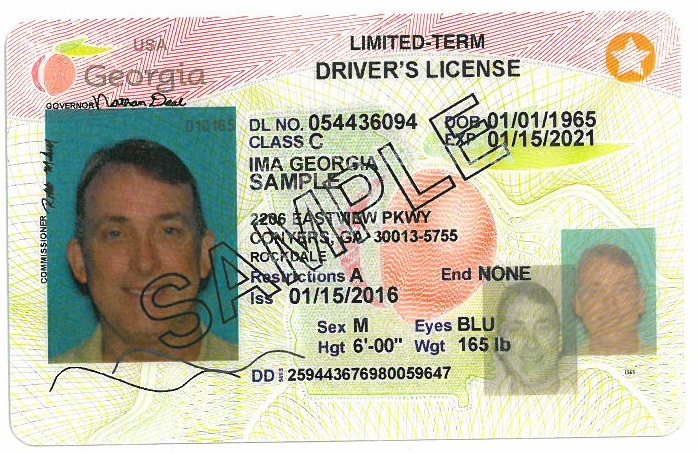
Two years ago I wrote a column for Insider Advantage Georgia informing readers that “the driver’s license Georgia issues to non-citizens – including illegal aliens who have already been ordered deported – is acceptable and “proper identification” when casting a ballot.”
Amazingly, that statement is still true.
When we voted in Cobb County this week I once again asked the very nice staffer who took my drivers license after asking me for identification if she would have accepted it if it read “limited term” across the top. I had to repeat myself and it was obvious she had never heard that description before.
When I made my question clear, she replied they accept any and all Georgia drivers licenses. Even if they are stamped “LIMITED TERM.” Her supervisor confirmed the answer to my question. So does DDS .
We hope readers will ask the same question when they vote. It seems like “an issue.”
For those who haven’t read the 2018 column, the Georgia Department of Driver’s Services (DDS) issues non-citizens drivers licenses and ID Cards that vary from the ones issued to U.S. citizens only in wording reading “LIMITED TERM.” It should be noted that in addition to legitimate guest workers and foreign students this includes a variety of illegal aliens who have been issued a work-permit.
It should also be noted that non-citizens – of any immigration status – are not supposed to vote in Georgia.
So why doesn’t state law make it clear that the default driving and ID credentials only given to aliens cannot legally be used or accepted at the polls? The weak and quiet answer to that question is usually that non-citizens cannot legally register to vote so we shouldn’t concern ourselves with details on voter’s ID offered at the ballot box.
Image: IPG
Considering the “Motor Voter” automatic registration system now implemented in Georgia it seems fair to demand a belt and suspenders on this one.
The left-tilted Georgia Public Broadcasting reported on Georgia’s “motor voter law” in February with “which means when you go to the DMV, the Department of Driver Services, and do any sort of anything, your voter registration is updated.”
“Georgia led the country in the next number of those motor voter interactions with well over 3.5 million. The number of people registered in Georgia increased by nearly a million voters from 2014 to 2018 according to the GPB report.
What could go wrong? We point to a 2019 Pew report on California Motor Voter as one example: “But DMV officials later found more than 100,000 registration errors in the first year, including some voters registered to the wrong party. And at least one noncitizen (state officials still are investigating how many in total) was accidentally signed up — a significant error since noncitizens aren’t allowed to vote.” *Update, 7 October, 2020: Here is another study on motor voter, from Michigan: Motor Voter Mahem: ‘Michigan’s Voter Rolls in Disrepair.’
Outgoing Rep Jeff Jones (R-St. Simons Island) dropped legislation (HB270) at the beginning of the 2019 General Assembly session that would have excluded the drivers license issued to foreigners from the state law on proper identification presented to poll workers. The legislation had an impressive list of cosponsors but never saw so much as a hearing. Thank you for trying, Rep. Jones.
Along with changing the default state ID credentials issued to foreigners to clearly illustrate the non-citizen status – not to mention illegal immigration status – we hope the legislature can manage this simple fix in 2021.
Change the laws.
Non-citizen ID should not be “proper ID” at Georgia polls and if the Republican-ruled state government is determined to reward illegal immigration, credentials issued to illegal aliens should not be identical to those given to legal immigrants and legal, temporary visa holders.
D.A. King is president of the Dustin Inman Society
A version of this essay appeared on the subscription news outlet Insider Advantage Georgia on October 23, 2020.
“Because of the greater number of prisoners received into USMS custody … total detention housing costs increased by approximately 1.9 percent … from $159 million to $162 million,” the DOJ report states.
Breitbart News:
Broken down, more than 53 percent of foreign nationals in federal prison last year were ordered deported before they were locked up for crimes. Another 36 percent of foreign nationals in prison were under investigation by federal immigration officials, and more than seven percent are being adjudicated as illegal aliens.
About 3.5 percent of foreign nationals in federal prison were legal immigrants being either adjudicated or shielded from deportation.
The average cost to American taxpayers to house foreign national convicts in just USMS facilities, not including BOP facilities, last year was $88.19 per prisoner every day.
“Because of the greater number of prisoners received into USMS custody … total detention housing costs increased by approximately 1.9 percent … from $159 million to $162 million,” the DOJ report states.
The DOJ report also detailed various cases such as one involving 30-year-old Colombian national Fredis Valencia Palacios. In 2016, he and c0-conspirators organized a human trafficking scheme where they arranged to smuggle illegal aliens into the U.S.
Three Cuban illegal aliens paid Palacios and his co-conspirators for the smuggling scheme, but when the illegal aliens were put on a boat headed for Miami, Palacios’ co-conspirators raped and murdered a female passenger and murdered a male passenger. The DOJ report states:
One of the co-defendants threw the male passengers overboard, anchoring them with rope to the inside of the boat. The surviving male victim reported that he heard the co-defendants sexually assault the female victim before cutting her throat and murdering her. The surviving victim also heard the co-defendants cut the other male victim’s throat, killing him. The survivor managed to escape by swimming and was subsequently rescued by the Colombian Navy.
Palacios was convicted in December 2018 and sentenced to 180 months in federal prison for his role in the smuggling scheme.
The new policy will give agents the ability to arrest and deport undocumented immigrants without a hearing in front of a judge
BuzzFeedNews
October 7, 202
Immigration and Customs Enforcement officials have started to implement a policy that allows officers to arrest and rapidly deport undocumented immigrants who have been in the US for less than two years, according to internal emails and documents obtained by BuzzFeed News.
The Trump administration’s effort — to expand quick deportations to undocumented immigrants across the US who cannot prove they have been in the country continuously for two years before they are picked up — was blocked by a federal court judge soon after the policy was first announced in 2019. But in June, the US Court of Appeals for the District of Columbia Circuit lifted the preliminary injunction, opening the door for ICE officers to use expedited removal across the country, a policy that will allow the agency to arrest and deport undocumented immigrants without a hearing in front of an immigration judge.
The previous policy only allowed officials to use expedited removal within 100 miles of the border and for those who have been in the country for up to two weeks.
Currently, officers typically arrest immigrants and place them into deportation proceedings. These include a hearing before an immigration judge — a process that can take years. In practical terms, the expanded policy gives ICE officers more power to determine who can be quickly deported, although it’s unclear exactly how fast the process will be.
The shift could allow the Trump administration to increase deportations while circumventing a court system that is severely backed up and short on resources, but advocates for immigrants have said it would destroy their due process rights…
Column: The issue driving the populist revolt has disappeared in 2020
Washington Free Beacon
Mathew Contineti – October 9, 2020
It is a sign of the times that immigration has not been mentioned in three hours of debate between the presidential tickets. A review of the transcripts of both the presidential and vice-presidential encounters finds no questions asked nor answers proffered about an issue that until only recently defined much of our politics and distinguished our two parties. Needless to say, both moderators wanted to know where the candidates stand on climate change, which routinely drifts toward the bottom of any list of public priorities.
Why the omission? It is tempting to say that immigration did not come up because the elites who manage the presidential debates are uncomfortable with the topic, are worried that the issue favors Republican border hawks, and are more interested in subjects relevant to their cultural coterie. But it is also true that presidential debates tend to focus on current events and pressing challenges, and that immigration just does not seem as great a concern today as the coronavirus, the economy, race relations and civil unrest, and California brushfires.
The apparent irrelevance of immigration and border security to the election might also be attributed to the achievements of the Trump administration. But these achievements are partial, tenuous, and dependent on events and relationships and court decisions. And they are easily reversed. What should worry the president is that the somnolence on the border deprives him of the very issue that propelled his rise to power, and that drove the populist revolt against the Washington establishment whose offshoots included the Ron Paul candidacies, the Tea Party, and Republican victories in 2014 and 2016. Immigration is next only to the economy and to the courts as a place where the president can contrast his record and agenda with Biden’s and appeal to national solidarity and historical tradition. His parlous electoral status may be related to the fact that immigration is not much of a factor in this most unusual campaign.
There is no gainsaying immigration’s importance to the Trump presidency. It was immigration that triggered the grassroots rebellion against the George W. Bush and Barack Obama administrations, and against congressional supporters of amnesty for illegal immigrants, culminating in Trump’s 2016 primary victory. Immigration became the touchstone of Trump’s campaign on day one and served as the cudgel by which he defeated Jeb Bush and other Republicans for whom the Bush-Obama approach to legalization was correct. The border wall was not only a rallying cry but also a symbol of how a Trump presidency would privilege American citizens above all else. And Trump fused immigration to economics, by opposing H-1B visas; to crime, by highlighting gang activity; and to national security, by enacting his travel ban against countries that sponsor terrorism.
Strong sentiments opposing the immigration of “paupers” developed in the United States well before the advent of federal immigration controls. During the colonial period, several colonies enacted protective measures to prohibit the immigration of individuals who might become public charges.[1] In the nineteenth century, before the existence of a federal agency responsible for overseeing immigration policies, eastern seaboard states such as New York and Massachusetts enacted state laws that restricted the immigration of aliens deemed likely to become dependent on public institutions such as poor houses. These states also charged steamship companies a “head tax” for each foreign passenger they landed in order to defray the cost of caring for, and sometimes removing, indigent immigrants who ended-up in state-funded facilities.[2]
Steamship companies, merchants, and others who favored open immigration challenged state head-taxes as impediments to free commerce. In response, state charity boards argued for the necessity of the head-tax in funding the care of foreign-born paupers and favored stronger protective laws to prevent additional influxes of destitute immigrants who could not support themselves.[3] The legal dispute over the state head-taxes reached a turning-point in 1875, when a lawsuit challenging the practice brought by a shipping company against the Mayor of New York reached the Supreme Court.[4] The Court decided that the state-imposed head-taxes interfered with Congress’s authority to regulate commerce and struck them down. Fearing the loss of funds needed to administer immigration policies and care for poor immigrants, eastern states began to lobby Congress for a federal immigration head-tax to replace the defunct state taxes.
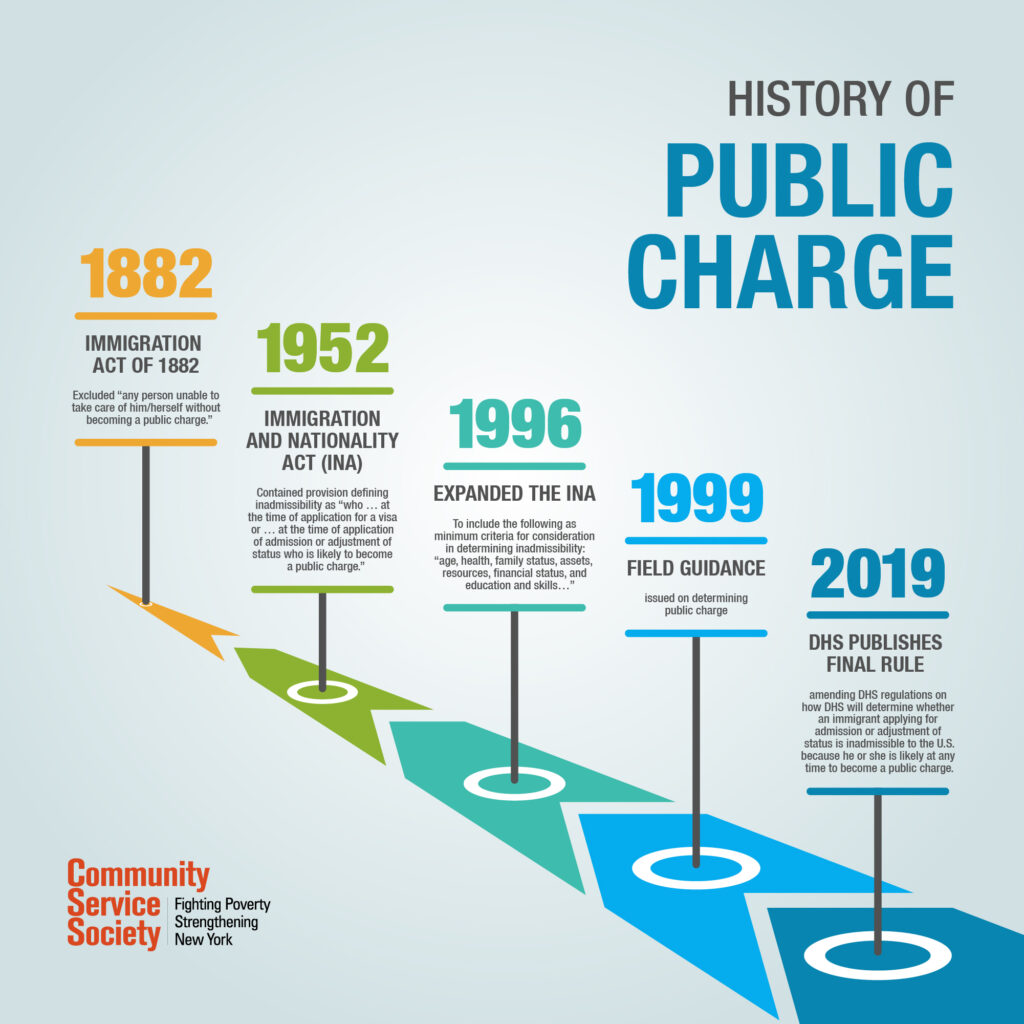
The eastern states’ concerns about poor immigrants and the cost of caring for them found expression in the first general federal immigration statute of 1882.[5] The 1882 law excluded “any person unable to take care of himself or herself without becoming a public charge.”[6] The 1882 Immigration Act also created a federal immigration head-tax, which was used to defray the cost of regulating immigration and to care for immigrants who arrived in the U.S., including those who fell into economic distress. However, the law did not create a federal immigration agency; instead it authorized the Secretary of the Treasury to enter into contracts with state immigration commissions to administer federal policies. Thus, in many ways, the 1882 federal law depended on state immigration commissions, who enforced the public charge exclusion policy and used money from the federal immigration head-tax fund to pay state and local charities that cared for immigrants.
While the 1882 federal law did not provide any definition of a “public charge” or any guidelines for determining who was likely to become one, state Immigration Commission reports suggest that officials took numerous factors into account, including an immigrant’s willingness to work, when making decisions in LPC cases. For example, in 1884 the Pennsylvania Board of Commissioners of Public Charities reported that a large number of Hungarians who were “poor, pecuniarily” were permitted to land because they were “strong, hearty people, and quite willing to work…”[7] In other cases the state boards landed questionable immigrants upon receiving guarantees from charitable organizations and/or bonds from the steamship companies that would be paid if the immigrants became public charges.
The general Immigration Act of 1891 completed the federalization of immigration regulation by creating the office of the Superintendent of Immigration and a federal Immigration Service to inspect all arriving aliens.[8] The 1891 law also retained the head-tax provision and the exclusion of “paupers or persons likely to become a public charge.”[9] In the Act of March 3, 1903 Congress added “professional beggars” as a class of exclusion.[10] A 1907 law then added additional language that excluded potential immigrants with a “mental or physical defect being of a nature which may affect the ability of such an alien to earn a living.”[11] The Immigration Act of 1917 added “vagrants” to the LPC provision and this version of it remained substantially unchanged when it was incorporated into the 1952 Immigration and Nationality Act.[12] The INA left the LPC policy substantively the same, but added language explicitly emphasizing the discretionary authority of administrative officers in the Department of State and the Immigration Service to determine the definition of “LPC.”[13] In sum, a version of the LPC provision has been part of federal immigration policy from its foundations and it consistently remained one of the most common grounds for immigrant inadmissibility.[14]
Brief History of Laws Providing for the Removal of Aliens Who Have Become Public Charges
In addition to providing for the exclusion of likely public charges, U.S. immigration law has long provided for the removal of immigrants who become dependent on public aid. The Immigration Act of 1891 established the federal government’s authority to remove aliens who entered unlawfully, a category that included immigrants who could be shown to have entered when they were LPC.[15] The 1891 Act also provided a deportability period of one year after arrival for immigrants who actually became public charges as the result of a condition that existed prior to their arrival. Congress extended this deportability period to two years in 1903 and three years in 1907[16]. The immigration Act of 1917 altered this provision, stipulating that aliens who became public charges “from causes not affirmatively shown to have arisen subsequent to landing” within five years of arrival were subject to deportation.[17] Additionally, the 1917 law removed the time limit on deportation: if an immigrant was shown to have become a public charge within five years of arrival they could be deported at any time, no matter how long they had resided in the U.S. The 1952 INA retained the provision that aliens who became public charges within five years of their arrival due to causes not affirmatively shown to have arisen since their entry could be deported at any time, and this has remained in the law since.
The Immigration Act of 1917 also provided for the removal at public expense of aliens who “fall into distress or need public aid from causes arising subsequent to their entry and are desirous of being so removed.”[18] Though not formal deportation, this law provided a means for the federal government to remove indigent aliens who desired to return to their home countries. During the Great Depression many aliens departed the United States under this voluntary provision.
New monthly report from ICE with a sample of criminal aliens busted by 287(g) partnerships.
Monthly 287(g) Encounter Report for August 2020
Report is informative reading, and demonstrates public safety value of immigration enforcement and cooperation between feds & locals.
U.S. Immigration and Customs Enforcement (ICE) 287(g) Program enhances the safety and security of communities by creating partnerships with state and local law enforcement agencies to identify and remove aliens who are amenable to removal from the United States.
The Illegal Immigration Reform and Immigrant Responsibility Act of 1996 added Section 287(g), to the Immigration and Nationality Act. This section of law authorizes the Director of ICE to enter into agreements with state and local law enforcement agencies, that permit designated officers to perform limited immigration law enforcement functions. Agreements under section 287(g) require the local law enforcement officers to receive appropriate training and to function under the supervision of ICE officers.