• Skip to primary navigation
  • Skip to main content
  • Skip to primary sidebar
  • Skip to footer
  • Home
  • DIS blog
  • Definition of terms – DHS
  • Birthright Citizenship
  • Contact us

Immigration Politics Georgia

looking for a better life • news and pro-enforcement opinion

  • Illegal Alien Lobby
  • georgiafornia
  • SPLC
  • report illegal aliens/illegal employers
  • Fast Facts from the original DIS blog

Sidebar/Content

Illegal aliens tampering with American elections, including in Georgia: L.A. Times – “How young immigrant ‘Dreamers’ made flipping control of the House a personal quest”

January 3, 2019 By D.A. King

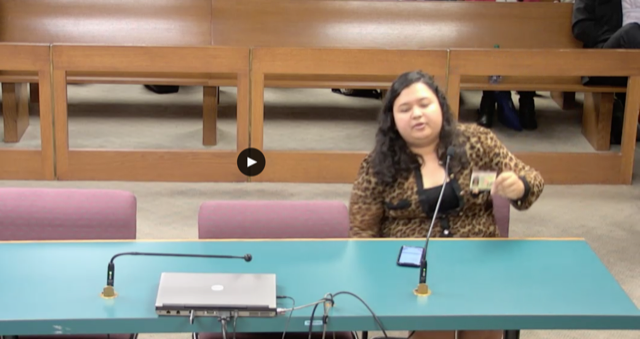
Maria Palasios, GALEO staffer and former illegal alien “dreamer” lobbying in the Georgia Capitol against passage of a bill to reform illegal alien drivers licenses, March, 2018. Image: DAKing

D.A. King

The L.A. Times has put out a news report about the hard work of the illegal aliens who former President Barack Hussien Obama granted executive amnesty with his DACA program to flip the U.S. House to Democrat control. As one who has watched these perpetually angry illegals – called “dreamers” by the liberal media – lobby against immigration enforcement and official English in the Georgia Capitol for the last five years, this writer can attest that they are quite active. And that many Republican state legislators are very timid in dealing with them. When the effort was made to end the current Georgia policy  of giving “dreamers” the same exact drivers license and ID Cards as legal immigrants and guest workers here on legal visas, it was these corporate-funded illegals who succesfully led the fight against passage. In 2012, Obama told us the the DACA illegals could never become U.S. citizens. That is not true. One of the “dreamers”  Maria Palasios is now a U.S. citizen and works for the far-left and discredited GALEO Corp. and has even run for stat office here in Georgia.

I wrote about that here.

The L.A. times story explains how involved and influential the illegal aliens – foreigners here illegally with a deferral on deportation – have become in American elections.

Imagine the influence the incoming batch of “dreamers” will have on American politics. Right now, there are about 15,000 “migrant” children, mostly from Central America, being cared for in shelters paid for by American tax dollars waiting to be distributed across the country. Along with “family units” who are setting records for crossing American borders, according to Customs and Border Protection, an average of 175 unaccompanied ‘children’ cross the southern border illegally every day. In a few years, they will be marching in the streets of America as teens and twenty-somethings screaming that they are “Americans without papers” and demanding another DACA-type amnesty. And, they will likely be successful. All the time, they will be lobbying in Washington DC and state Capitols as victims of borders and intimidating politicians who would rather capitulate than risk name-calling by the left and the media. Sorry for the repetition.

From the L.A. Times:

“Gabriela Cruz, who was brought to the U.S. illegally when she was 1, couldn’t vote, but in the final hours before the Nov. 6 election, she was making one last run to get people to the polls.

The sun was setting in Modesto when she found Ronald Silva, 41, smoking a cigarette on a tattered old couch behind a group home. He politely tried to wave her off until she reminded him he had a right that she as an immigrant without citizenship didn’t have.

“It could really make a change for us,” said Cruz, 29.

Half an hour later, she was helping Silva look up candidates as he filled out his ballot by the light of her phone. “I’m glad you guys came,” he said. “I was going to leave it in my drawer.”

Young immigrants, known as “Dreamers,” have become a political force over the last two decades as they have pushed Congress to overhaul the nation’s immigration laws. Part of a new wave of immigrant activists who mobilized this year to return control of the House to Democrats, Cruz and others in the movement see in President Trump an existential threat to their futures, and to their friends and family.”

The entire piece can be read here.

Filed Under: Recent Posts Achrives

Fast Fact: Georgia Dept. of Drivers Services (DDS): “A Georgia DL/ID is not proof of lawful status in the U.S….”

January 3, 2019 By Bill Buckler

Image: Georgia DDS

DDS: “A Georgia DL/ID is not proof of lawful status in the U.S. …”

Here

Almost on the bottom.

Filed Under: Fast Facts Archives Tagged With: Images Right

Fast Fact: DHS: Myth vs Fact on Central American invasion mob

January 2, 2019 By Bill Buckler

Image: DHS

Myth vs. Fact: Caravan (November 1, 2018, from DHS)

Here.

Filed Under: Fast Facts Archives Tagged With: Threaded Comments, caravan, mob, invasion, DHS

Spring, 2018: GOP Blocks Georgia Immigration Enforcement Bill, But OKs Traffic Cameras

January 1, 2019 By Bill Buckler

Breitbart News

April 15, 2018

DA King: GOP Blocks Georgia Immigration Enforcement Bill, But OKs Traffic Cameras

The Republican Speaker of the Georgia House blocked a bill that would help deport criminal illegal aliens, but he pushed through a last-minute bill touted by his lobbyist son, according to the Atlanta Journal-Constitution.

The paper reported April 12:

Georgia House Speaker David Ralston delayed the end of this year’s legislative session past a midnight deadline so lawmakers could vote on a bill to allow speeding ticket cameras in school zones.

The bill was pushed by Ralston’s son, a lobbyist for an Arizona-based company, American Traffic Solutions, that sells the camera systems to local governments.

…

Ralston and Lt. Gov. Casey Cagle, the president of the state Senate, agreed to continue working past midnight to allow the House to approve the bill after it had passed the Senate a few minutes earlier, said Kaleb McMichen, a spokesman for Ralston, a Blue Ridge Republican.

In contrast, Ralston refused to allow a vote on a public safety bill in the GOP-dominated House before ended its annual session on March 30. Corporate-funded anti-borders groups took credit for the defeating the bill, which would have required state officials to notify federal immigration-enforcement officers of illegal migrants in the state’s jails.

Image: ICE, via AP and Breitbart News
GOP leaders offered excuses for blocking the popular immigration-reform bill

“We ran out of time before we had finished all the bills that were worthwhile,” said House Majority Whip, Christian Coomer. “Other bills took priority and SB452 wasn’t called before the clock struck midnight,” he told the liberal Atlanta Journal-Constitution newspaper. Read the rest here. 


Filed Under: Recent Posts Achrives

Opinion: IERB dismissed my complaints without allowing presentation of any evidence – Plyler v Doe does not apply to public benefits for parents of illegal aliens

January 1, 2019 By D.A. King

Image: Bensbiltong.com


IERB complaints: responses to responses


1) The 1982 SCOTUS Plyler v Doe decision made us do it:


Plyler v. Doe has essentially guaranteed a right to pursue a high school diploma to all students (children) regardless of immigration status. It applies to K-12 education.


An easy to read and accurate synopsis: Plyler v. Doe, 457 U.S. 202 (1982), was a case in which the Supreme Court of the United States struck down both a state statute denying funding for education to undocumented immigrant children and a municipal school district’s attempt to charge undocumented immigrants an annual $1,000 tuition fee for each undocumented student to compensate for the lost state funding.[1] The Court found that any state restriction imposed on the rights afforded to children based on their status as immigrants must be examined under an intermediate scrutiny standard to determine whether it furthers a “substantial” government interest.


The application of Plyler v. Doe has been limited to K-12 schooling. Other court cases and legislation such as Toll v. Moreno 441 U.S. 458 (1979) and the Illegal Immigration Reform and Immigrant Responsibility Act of 1996[2] have allowed some states to pass statutes that deny undocumented immigrants students eligibility for in-state tuition, scholarships, or even bar them from enrollment at public colleges and universities.


Plyler v Doe applies to admittance, enrollment and education of illegal alien students in K-12 . It does not provide for any education of parents of students. Neither does it mean that school systems can or should provide any public benefit to parents (adults) in the name of furthering the education of the child/student. The argument that parents of illegal aliens are somehow exempt from proving eligibility for public benefits because of Plyler v Doe is absurd. Do we also exempt parents from proving work eligibility under Georgia’s E-Verify laws? Are parents of illegal aliens excluded for the affidavit process in 50-36-1 and 13-10-91 because they have children in Georgia K-12 schools? (No).


The USDOE has distributed guidance letters which are linked below. Although many of the responses from Georgia school districts cite Plyler v Doe and these letters as evidence of the legality of adult education for already enrolled K-12 students, the letters all clearly address enrollmentof K-12 students, not adult education.


The (English) guidance documents:
http://www.ed.gov/about/offices/list/ocr/letters/colleague-201405.pdf
http://www.ed.gov/about/offices/list/ocr/docs/qa-201405.pdf
http://www.ed.gov/about/offices/list/ocr/docs/dcl-factsheet-201405.pdf


Lastly, the argument that verifying the eligibility/immigration status of parents for public benefits or not providing illegal aliens parents (adults) of K-12 students language classes hinders the education of the child can be expanded to say that we cannot verify the legal status of the parents for a teaching or contractor job in the school system and that use of the E-Verify or SAVE system aimed at a parent is a “civil rights violation” or somehow damages the child’s education. Taken to extremes, use of the E-Verify system for parents of any or all Georgia K-12 students could be said to hinder the education of an illegal alien’s child because the parent cannot lawfully be employed. Shorter: The Plyer v Doe argument is intended for people who do not know the law.


2) Title lll made us do it and authorizes English classes for illegal alien parents of K-12 students already enrolled in Georgia’s school system.


I do not dispute that there is language in Title lll concerning parents and English language assistance. But partial quoting of Title lll without noting the federal requirement that all programs be in compliance with individual state law is incomplete and deceptive.


I insert a link to Title III text here


Title III — Language Instruction for Limited English Proficient and Immigrant Students


Please note Section 3116 Local Plans “(a) PLAN REQUIRED – Each eligible entity desiring a subgrant from the State educational agency under section 3114 shall submit a plan to the State educational agency at such time, in such manner, and containing such information as the State educational agency may require.

(b) CONTENTS – Each plan submitted under subsection (a) shall —

…(1) each local educational agency that is included in the eligible entity is complying with section 3302 prior to, and throughout, each school year;

(2) the eligible entity annually will assess the English prof iciency of all children with limited English proficiency participating in programs funded under this part;

(3) the eligible entity has based its proposed plan on scientifically based research on teaching limited English proficient children;

(4) the eligible entity will ensure that the programs will enable children to speak, read, write, and comprehend the English language and meet challenging State academic content and student academic achievement standards; and

à(5) the eligible entity is not in violation of any State law, including State constitutional law, regarding the education of limited English proficient children, consistent with sections 3126 and 3127.


And Section 3126 LEGAL AUTHORITY UNDER STATE LAW.

à“Nothing in this part shall be construed to negate or supersede State law, or the legal authority under State law of any State agency, State entity, or State public official, over programs that are under the jurisdiction of the State agency, entity, or official.


SEC. 3127. CIVIL RIGHTS.

Nothing in this part shall be construed in a manner inconsistent with any Federal law guaranteeing a civil right. Use of Funds Requirements in OMB Circular A – 87


3) Title lll and Title l made us do it:


“Translation and Interpretation for English Learners – Requirements under Title VI of the Civil Rights Act of 1964 Related to National Origin Discrimination and Use of Funds Under Title III, Part A andTitle I, Part A of the ESEA.” See linked info ( for some reason, the link must be pasted into your browser to open the fed document).https://www2.ed.gov/programs/titleiparta/titleititleiii421.pdf


“Office of Management and Budget (OMB) Circular A – 87 requires that the use of funds for a specific purpose be: necessary and reasonable for the proper and efficient performance and administration of the program; and authorized and not prohibited under State and local laws or regulations.

—


Filed Under: Immigration Research Archives

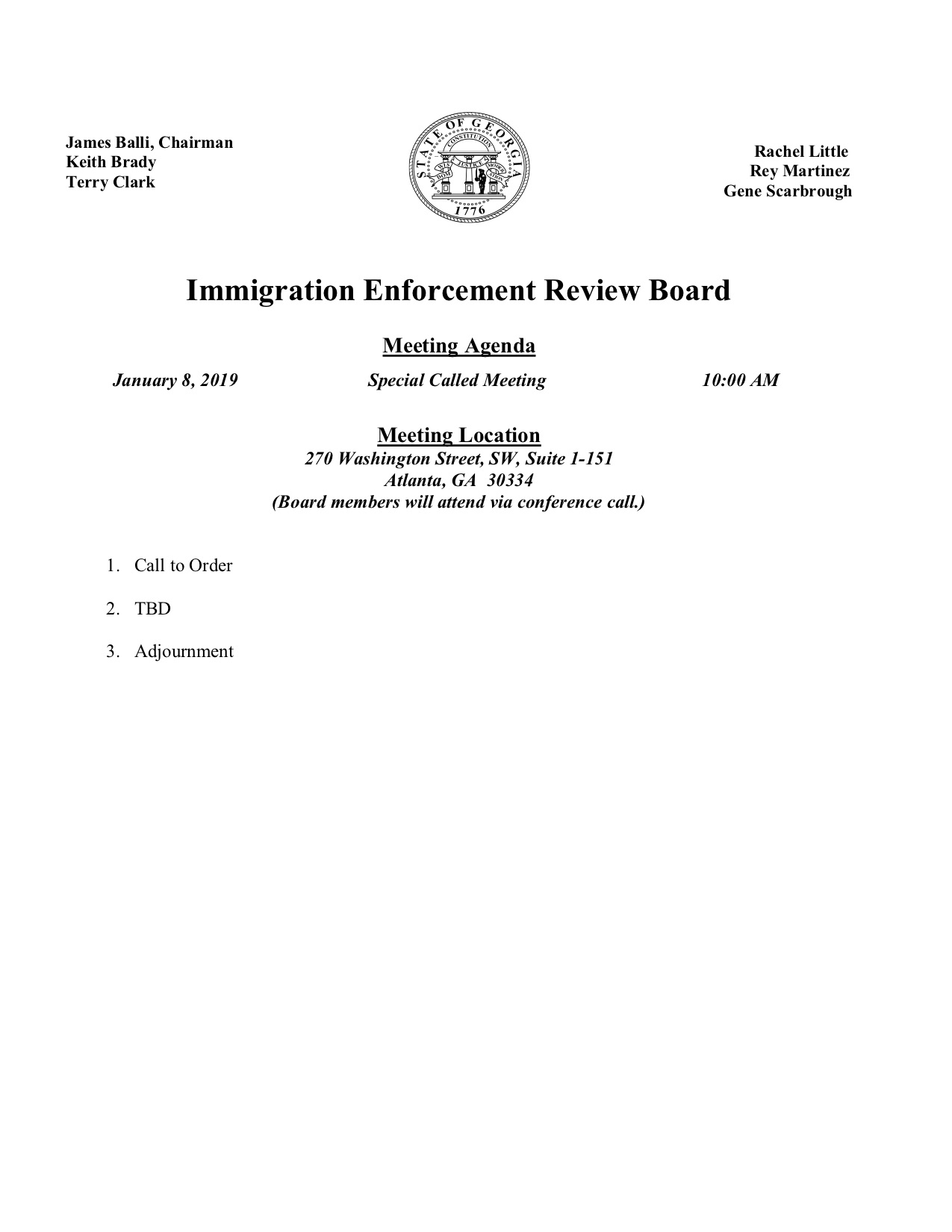
Opinion: Kangaroo Court? Georgia’s Immigration Enforcement Review Board (IERB) calls a special meeting with agenda to be determined : It’s via telephone and if you want to hear it, you must go to downtown Atlanta and through security

January 1, 2019 By D.A. King

Image:Bensbiltong.com

__

Email received from Audits and Accounts, December 31, 2018 at 3:38 PM:

Good Afternoon,

The Immigration Enforcement Review Board has scheduled a Special Called Meeting for Tuesday, January 8, 2019 at 10:00.  The members will be holding this meeting via conference call.  A conference call line will be set up in Room 1-151 at the Georgia Department of Audits and Accounts if you wish to hear the meeting in person.  The address for the Georgia Department of Audits and Accounts is listed on the agenda.  The building is located at the corner of Trinity Avenue and Washington Street.  Please enter the building on the Trinity Avenue side.  You will need to go through security and show a valid ID to enter the building.  I have attached a tentative agenda, but will resend.

Thank you,

Carol Schwinne

Carol G. Schwinne| DirectorAdministrative Division

Georgia Department of Audits and Accounts

270 Washington Street, S.W., Suite 1-156

Atlanta, GA 30334

Office: 404.463-2670 | schwinne@audits.ga. gov

  audits.ga.gov  


mail.audits.ga.gov made the following annotations on 12/31/18:

NOTICE: This e-mail (including attachments) may contain information that is confidential and legally privileged. If you are not the intended recipient, you are hereby notified that you have received this document in error and that any review, dissemination, distribution or copying of this message is strictly prohibited. If you have received this in error, please notify us immediately and delete the message.

Thank you for your cooperation.

__

***Note: More on the IERB here and here.

Filed Under: Recent Posts Achrives

U.S. Central American Immigrant Population Increased Nearly 28-Fold since 1970

December 30, 2018 By D.A. King

Center for Immigration Studies

Central American Immigrant Population In U.S. Increased Nearly 28-Fold since 1970

Poverty and welfare use double that of native-born Americans

By Steven A. Camarota and Karen Zeigler on November 1, 2018

Recent news coverage of a caravan from Central America hoping to enter the United States illegally has raised interest in the number and characteristics of Central Americans in the country. A new analysis by the Center for Immigration Studies of the latest Census Bureau data, which includes legal and illegal immigrants, shows that the size of the Central American immigrant population (from Guatemala, El Salvador, Belize, Honduras, Nicaragua, Costa Rica, and Panama) has grown enormously in recent decades. It also shows immigrants from the region often struggle with high rates of poverty and welfare use and low average incomes. The reason this is the case is not due to an unwillingness to work. In fact, Central Americans (ages 18 to 64) are slightly more likely to hold a job than native-born Americans. Rather their high rates of poverty and welfare use are due to their low levels of education, which, as their numbers have soared, have declined dramatically relative to natives.

Among the findings:

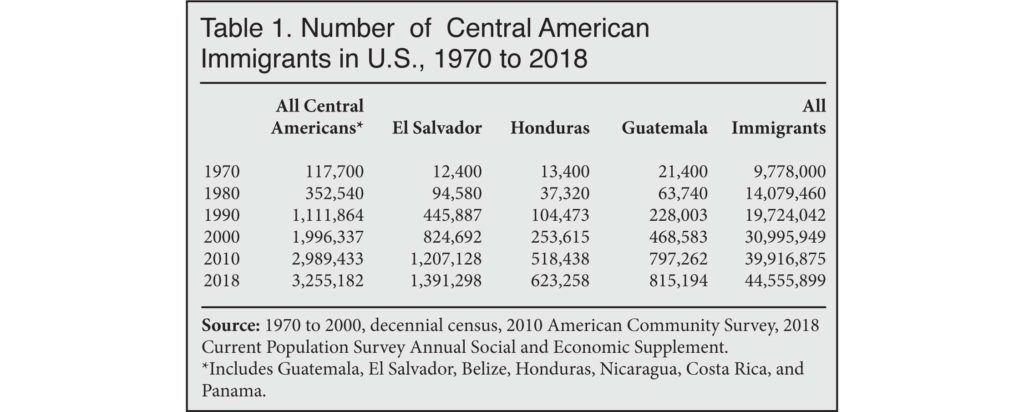
  • The number of immigrants from Central America (legal and illegal) has grown 28-fold since 1970, from 118,000 to nearly 3.3 million in 2018 — six times faster than the overall immigrant population.
  • In 2018, 87 percent of Central American immigrants came from three countries — El Salvador, Guatemala, and Honduras.
  • El Salvador is the largest sending country from the region, with 1.4 million immigrants in the United States, a 112-fold increase since 1970. Guatemala is second with 815,000, followed by Honduras with 623,000.
  • Based on prior estimates by the Department of Homeland Security, slightly more than half of El Salvadorans are in the country illegally, as are about two-thirds of Guatemalans and Hondurans.1
  • A large share of Central Americans struggle in the United States, but it is not because they are unwilling to work. In fact, 76 percent of working-age immigrants from the region had a job in the first part of 2018, compared to 73 percent of the native-born.
  • The primary reason so many Central Americans are poor and access welfare is that, as their population has grown in the United States, their education level relative to natives has declined dramatically:
    • In 1970, 49 percent of Central Americans had not completed high school, compared to 42 percent of natives — a seven percentage-point gap. In 2018, 47 percent of Central Americans had not completed high school, compared to 6 percent of natives — a 41 percentage-point gap.
    • In 1970, 4 percent of Central Americans had at least a bachelor’s degree, compared to 5 percent of natives — a one percentage-point gap. In 2018, 10 percent of Central Americans had at least a bachelor’s degree, compared to 38 percent of natives — a 28 percentage-point gap.
  • Because such a large share of Central Americans have modest levels of education, the share of immigrants and their young children from the region who live in poverty is twice that of natives — 22 percent vs. 11 percent.
  • Perhaps most troubling, 31 percent of the children (under age 18) of Central Americans live in poverty, roughly double the 16 percent rate for the children of natives. Also, 66 percent of the young children of Central Americans live in or near poverty.
  • On average, Central Americans make only 61 percent as much as the average native-born American. Even Central Americans who have lived in the country for more than 10 years still only have 65 percent of the average income of the native-born.
  • Given the large share of Central Americans with low incomes, it is not surprising that so many access the welfare system. In 2018, 56 percent of households headed by Central American immigrants used one or more major welfare programs, more than double the 26 percent of native households.
  • The welfare figures for 2018 come from the Current Population Survey (CPS), which understates welfare use, particularly among immigrants. So the actual welfare use rates are even higher than those reported here.2
  • Although illegal immigrants and new legal immigrants are barred from most welfare programs, the restrictions do not apply to all programs. Moreover, some states allow otherwise ineligible immigrants to access programs at state expense; and most important, immigrants, including illegal immigrants, can receive benefits on behalf of U.S.-born children, who are awarded citizenship at birth.
  • The high welfare use of Central Americans reflects the fact that, while most work, their education levels mean they often earn low wages in the modern American economy and are unable to support themselves or their own children in many cases and turn to American taxpayers by using the welfare system.
  • Welfare use is common among both recently arrived and more established Central Americans. Among households headed by Central Americans in the country for 10 years or less, 55 percent used one or more welfare programs, while the figure is 56 percent for households headed by a Central American in the country for more than 10 years.
  • Welfare use is very high for all three top-sending countries from the region. Of households headed by El Salvadoran immigrants, 60 percent use at least one major welfare program; the figure is 59 percent for Guatemalans and 52 percent for Hondurans.
  • Overall, Central American households’ use of cash welfare is similar to that of native households, but the share of Central American households receiving some type of food assistance is 2.5 times that of natives — 36 percent vs. 14 percent. The share of Central American households with at least one person on Medicaid is more than double that of native households — 45 percent vs. 20 percent. Read the rest here.
Image: CIS.org


Filed Under: Recent Posts Achrives

Fast Fact: Feds: 1100 “migrants” caught everyday on southern border

December 30, 2018 By Bill Buckler

Caption: Twitter

Fast Fact: 

1100 Migrants Apprehended Daily Along U.S.-Mexico Border, Say Feds

Here.

Filed Under: Fast Facts Archives Tagged With: Headlines

U.S. Senator Chuck Schumer (D-NY) on the crime of illegal immigration – VIDEO, 2009

December 28, 2018 By D.A. King

Filed Under: Immigration Research Archives

Cato Institute: Forget the Wall Already, It’s Time for the U.S. to Have Open Borders

December 28, 2018 By D.A. King


Jeffery Miron, image: CATO INSITUTE.

Jeffrey Miron is director of economic studies at the Cato Institute and the director of undergraduate studies in the Department of Economics at Harvard University.

Cato Institute

Forget the Wall Already, It’s Time for the U.S. to Have Open Borders

By Jeffrey Miron
This article appeared on USA Today on July 31, 2018.

“President Donald Trump’s recent tweets against open borders come as no surprise. Indeed, even fervent immigration advocates worry that open borders would lower the wages of low-skilled natives, erode national security, and overburden the social safety net. Trump doubled down, tweeting that he would be “willing to ‘shut down’ government” unless Congress approves funding for a border wall with Mexico.

Trump, however, has it exactly backwards: The solution to America’s immigration problems is open borders, under which the United States imposes no immigration restrictions at all. If the U.S. adopts this policy, the benefits will far outweigh the costs.

Legalize ALL immigration

Illegal immigration will disappear, by definition. Much commentary on immigration — Trump and fellow travelers aside — suggests that legal immigration is good and that illegal immigration is bad. So, legalize all immigration.

America has nothing to fear, and much to gain, from open borders.

Government will then have no need to define or interpret rules about asylum, economic hardship, family reunification, family separation, DACA (Deferred Action for Childhood Arrivals) and so on. When all immigration is legal, these issues are irrelevant.

The question of fairness about who enters first — those who waited in line or those who entered illegally — disappears. Amnesty for existing illegal immigrants also becomes a non-issue. Or an open borders policy could require anyone who entered illegally to exit the country — for exactly five minutes — and then re-enter legally.

Think about the money we could save and make

Expenditure on immigration enforcement would shrink to nothing, because open borders means no walls, fences, screening at airports, ICE (Immigration and Customs Enforcement), deportations, detention centers or immigration courts. A 2013 report estimated that immigration enforcement cost more than $18 billion annually, and standard indicators suggest costs have grown further since then.

Last year, U.S. employers filed over 336,000 petitions for H1-B visas for highly skilled foreign workers, but only 197,129 were approved. Complicated visa rules – for tourists versus job-seekers, STEM (science, technology, engineering and math) workers versus agricultural laborers, and students versus non-students – would all vanish. This would save resources and give employers new access to talented human capital.

The time people waste re-entering the country will evaporate. How often do you face long delays when entering Oklahoma from Texas? Never. But how often do you experience delays when you leave other countries for the United States? Almost always. One study pegs the cost of wait times at the U.S.-Mexico border alone to be more than $12 billion a year.

Economic efficiency will increase both in the USA and in immigrant-sending countries, because different kinds of labor will be better matched around the world to their most productive activity. This benefits the immigrants who earn higher incomes, but also U.S. consumers who face lower prices for imported goods and services. One academic study predicts that if borders were open everywhere, world gross domestic product could be twice its current value.

They will send their best…” Read the rest here. 

Filed Under: Recent Posts Achrives

  • « Go to Previous Page
  • Page 1
  • Interim pages omitted …
  • Page 68
  • Page 69
  • Page 70
  • Page 71
  • Page 72
  • Interim pages omitted …
  • Page 74
  • Go to Next Page »

Primary Sidebar

 “Journalism is printing what someone else does not want printed: everything else is public relations.” Attributed to George Orwell.

miss something? see Post Archives and fast facts archives here

Categories

Brian Kemp
Photo: mdjonline.com

#BigTruckTrick

Days since GA Gov. Brian Kemp promised action on 'criminal illegals,' sanctuary cities, a criminal alien registry and related legislation:

2628

The Southern Poverty Law Center: Part Karl, Part Groucho

An Illegal Alien in Georgia Explains How To Drive Illegal Aliens Out of Georgia – SB529, 2007

https://youtu.be/oxe1WO27B_I

Gwinnett County, GA Sheriff Kebo Taylor and state law


About the author (click photo)

DA King

Foreign cops & lower college tuition for illegals than Americans, anyone? *Complete coverage of GA. House Study Committee “Innovative Ways to Maximize Global Talent”

ANSWERING THE SMEARS AJC/SPLC

Answering the smear: “blow up your buildings…” How a lie passed on by the AJC in 2007 is still being used against D.A. King (me)

FOREVER 16: REMEMBER DUSTIN INMAN

The Southern Poverty Law Center – a hate mongering scam

https://youtu.be/qNFNH0lmYdM

IMMIGRATION & WORLD POVERTY – GUMBALLS

https://youtu.be/LPjzfGChGlE?t=1

       CATO INSTITUTE: OPEN BORDERS

Georgia is home to more illegal aliens than green card holders

More illegal aliens than lawful permanent residents (green card holders) Image: GBPI.org

On illegal immigration and Georgia’s higher-ed system

Illegal aliens protest to demand "equity." Image: Twitter

Footer

Follow these immigration experts on Twitter

Follow these immigration experts on Facebook

contact georgia state legislators

State House Reps and state senators – contact georgia state legislators here.

If you don’t know who represents your and your family in Atlanta, you can find out here.

Contact the Georgia Delegation in Washington

Contact info for the Georgia delegation in Washington DC here. Just click on their name.

Copyright © 2026