• Skip to primary navigation
  • Skip to main content
  • Skip to primary sidebar
  • Skip to footer
  • Home
  • DIS blog
  • Definition of terms – DHS
  • Birthright Citizenship
  • Contact us

Immigration Politics Georgia

looking for a better life • news and pro-enforcement opinion

  • Illegal Alien Lobby
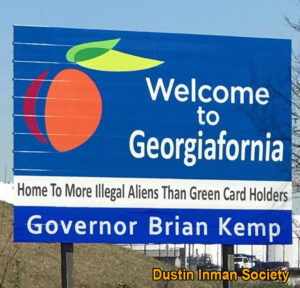
  • georgiafornia
  • SPLC
  • report illegal aliens/illegal employers
  • Fast Facts from the original DIS blog

Blog Page

Governor Kemp breaks silence on illegal immigration

December 4, 2019 By D.A. King

Image: Dustin inman Society


Despite campaign promises, Kemp is mostly mum


 In a twenty-minute press conference in his office Wednesday morning, Georgia Governor Brian Kemp formally announced his pick to replace retiring Senator Johnny Isakson. It is notable that in his introduction speech for businesswoman and political trainee Kelly Loeffler, Kemp broached the topic of border security and illegal immigration.

As far as we can tell, this is Kemp’s first public remark related to illegal immigration since the 2018 election. We offer a no-cost, hand car wash to anyone who can accurately cite a quote or remark from Kemp on the issue since then.

“Senator Loeffler will fight to strengthen our immigration laws and finish the Border Wall so we can stop Mexican drug cartels from flooding our streets – here in Georgia – with drugs, weapons, violence, and fear” said Kemp.

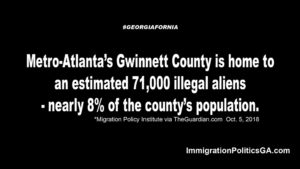
According to the Georgia Budget and Policy Institute, Georgia is home to more illegal aliens than green card holders. The U.S. Department of Homeland Security ranks the Peach State ahead of Arizona in its population of “undocumented workers.”

Kemp’s silence and blatant disregard for the issue is in defiance of his detailed campaign outline for a state “track and deport plan” in which he pledged to “create a comprehensive database to track criminal aliens in Georgia.” “He will also update Georgia law to streamline deportations from our jails and prisons” and to create a criminal alien database” went the promise.

Still shocked by his inaction on illegal immigration in his first year, pro-enforcement political insiders paying attention to legislation in the Georgia Capitol are carefully watching to see if Kemp will put the power of his office – and begin to honor his campaign promises – by pushing for a simple bill that was held up in the Republican-ruled House in the 2019 session. HB 202 from Rep Jesse Petrea would require the state Department of Corrections to post a quarterly, public report citing the number of foreigners in the prison system, their immigration status, home nation and crimes for which they are serving time.

The measure was stopped in the House Rules Committee and must now begin the hearing process from the beginning, according to the House Clerk’s office.

While it does not begin to approach the tough-talk promises of action on criminal aliens from candidate Kemp, the end result of the Petrea’s HB 202 becoming law would be that Georgia taxpayers would have access to hard, official, indisputable data on at least one part of the cost of illegal immigration – which is one reason the bill was smothered last year by business-first Republican leadership.

A simple one-pager, HB 202 is still alive and has the votes to pass. As this writer noted elsewhere, Kemp could have ordered the DOC to begin the data sharing last year. But he didn’t.

Image: Brian Kemp -National Review/Reuters

 Illegal immigration is still an issue for Georgians

  • A likely illegal alien was arrested in Marietta last month and charged with molesting at least two boys.
  • Pro-enforcement Americans are fighting against the marxist radicals in Gwinnett and Cobb Counties who are waging a very carefully staged war on ICE, immigration enforcement and the lifesaving 287 (g) operations in those jurisdictions.
  • Despite a state law requiring participation, the Georgia Department of Public Safety is not in the 287(g) program.
  • Jerry Gonzalez, leader of the corporate-funded and anti-enforcement GALEO told a metro-Atlanta newspaper that verifying ID and hiring records with use of the no-cost IMAGE certification is a “white nationalist agenda.”
  • Readers not familiar with the folks at GALEO or Gov. Kemp’s relationship with them may want to see the angry letter from a retired immigration agent to the governor here.
  • It could be worse. Election runner-up Stacey Abrams’ “New Georgia Project” is in open opposition to ICE even operating in Georgia.

We make the same no-cost car wash offer to anyone who can cite any comment from Governor Kemp on any of the above examples.

“I got a big truck”

Perhaps most obvious to voters who can remember back to last year is candidate Kemp’s “yep, I just said that…” campaign ad shtick that involved his “I got a big truck” (video) and the possibility of his personally rounding up “criminal illegals.”

Asking about the current whereabouts of the truck seems a fair question for Governor Kemp from the faithful GOP voters.

From here, we will begin to produce regular updates on Governor Kemp’s campaign promises, his silence – or any actions – on the illegal immigration crisis in Georgia

Stay tuned.

*Note: Here is a link to Gov. Brian Kemp’s contact page, but unless my vision is worse than usual, it seems he has removed the phone number from the page. If so, here it is: 404-656-1776



Filed Under: Recent Posts Achrives

Fast Fact: Anti-borders posts on social media spreading misinformation concerning alleged ICE activity – ICE Media Release

November 26, 2019 By D.A. King

Image: Twitter
ENFORCEMENT AND REMOVAL
11/25/2019

Social media spreading misinformation concerning alleged ICE activity

REDMOND, Wash. – A statement posted to social media, Nov. 23, is a prime example of the reckless, irresponsible misinformation that continues to mislead the public concerning the mission of U.S. Immigration and Customs Enforcement (ICE).

The allegations that ICE entered the Redmond United Methodist church this weekend, or dressed as a homeless woman to enter a homeless shelter located within the church, are false and do nothing but promote fearmongering. ICE did not enter the Redmond United Methodist Church, nor was the agency conducting operations near that location at any time this weekend.

ICE maintains that cooperation by local officials and the community are an indispensable component of promoting public safety. Policy makers who strive to make it more difficult to remove dangerous criminal aliens and aim to stop the cooperation of local officials and business partners, harm the very communities whose welfare they have sworn to protect. Here.

Bonus fast fact:

Filed Under: Fast Facts Archives

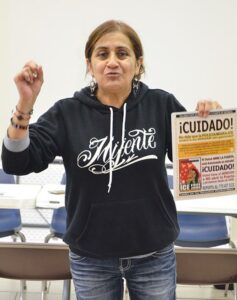
Abolish ICE! Marxist Georgia group (GLAHR) led by a Mexican citizen screams at passing traffic

November 21, 2019 By D.A. King

ICE, ICE, ICE!! ABOLISH ICE! #AbolishICE pic.twitter.com/t0DW622dih

— GLAHR (@GLAHR_) November 20, 2019

It’s a short video they posted.


Here are members of the Soros-funded ( see also Ford Foundation) open borders ‘Georgia Latino Alliance for Human Rights’ (GLAHR) screaming at cars in traffic to “Abolish ICE.” This is one of the Marxist groups invited to a Gwinnett County (GA) July 31 panel discussion on 287(g) by Commissioner Marlene Fosque. They dropped out when they found out this pro-enforcement writer was on the panel.

GLAHR was founded by a now room-temp Mexican diplomat (Teodoro Maus) and Mexican-born Adelina Nichols, who has ties to the communist party. GLAHR is part of a larger group demanding that Atlanta officially become a sanctuary city.

Adelina Nichols. Photo: Savannah Morning News

It’s not only 287(g) they hate.

These are people who advocate to abolish the entire federal ICE agency and end any enforcement of human trafficking, immigration or borders.

Filed Under: Recent Posts Achrives

DACA: include Murder, Rape, Weapon and Assault Charges – USCIS Releases Report on Arrest Histories of Illegal Aliens who Request DACA

November 16, 2019 By D.A. King

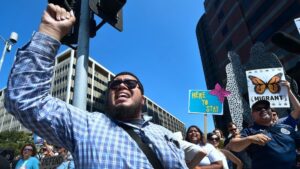
DACA protester. Photo: Getty Images

USCIS Releases Report on Arrest Histories of Illegal Aliens who Request DACA

– 

WASHINGTON—Today, U.S. Citizenship and Immigration Services (USCIS) updated data  (PDF, 756 KB) on arrests and apprehensions of illegal aliens who requested Deferred Action for Childhood Arrivals (DACA).

The release of this report reflects the agency’s ongoing focus on transparency. The report provides updated information on known arrests and apprehensions of DACA requestors. The data may include arrests that did not result in convictions or where the charges were dropped or otherwise dismissed.

Among the findings of the release are the following:

  • Nearly 110,000 DACA requestors out of nearly 889,000 (12%) had arrest records. Offenses in these arrest records include assault, battery, rape, murder and driving under the influence.
  • Of approved DACA requestors with an arrest, 85% (67,861) of them were arrested or apprehended before their most recent DACA approval.
  • Of approved DACA requestors with an arrest, more than 31% (24,898) of them had more than one arrest.
  • Of all DACA requestors, 218 had more than 10 arrests. Of those, 54 had a DACA case status of “approved” as of October 2019.

“As DACA continues to be the subject of both public discourse and ongoing litigation, USCIS remains committed to ensuring transparency and that the American people are informed about those receiving DACA,” said USCIS Acting Director Ken Cuccinelli. “This agency is obligated to continue accepting DACA requests from illegal aliens as a direct result of the previous administration’s decision to circumvent the laws as passed by Congress. We hope this data provides a better sense of the reality of those granted the privilege of a temporary deferral of removal action and work authorization under DACA.”

Under current DACA guidelines, illegal aliens may be considered for DACA if they have not been convicted of a felony, significant misdemeanor, or three or more “non-significant” misdemeanors not arising out of the same act, omission or scheme of misconduct, and they do not otherwise pose a threat to national security or public safety. The number of arrests illegal aliens have do not necessarily disqualify them from receiving DACA as a matter of discretion.

For more information on USCIS and its programs, please visit uscis.gov or follow us on Twitter (@uscis), Instagram (/uscis), YouTube (/uscis), Facebook (/uscis), and LinkedIn (/uscis).


Filed Under: Immigration Research Archives

What Is DACA? Is it a rule or is it prosecutorial discretion?

November 16, 2019 By D.A. King

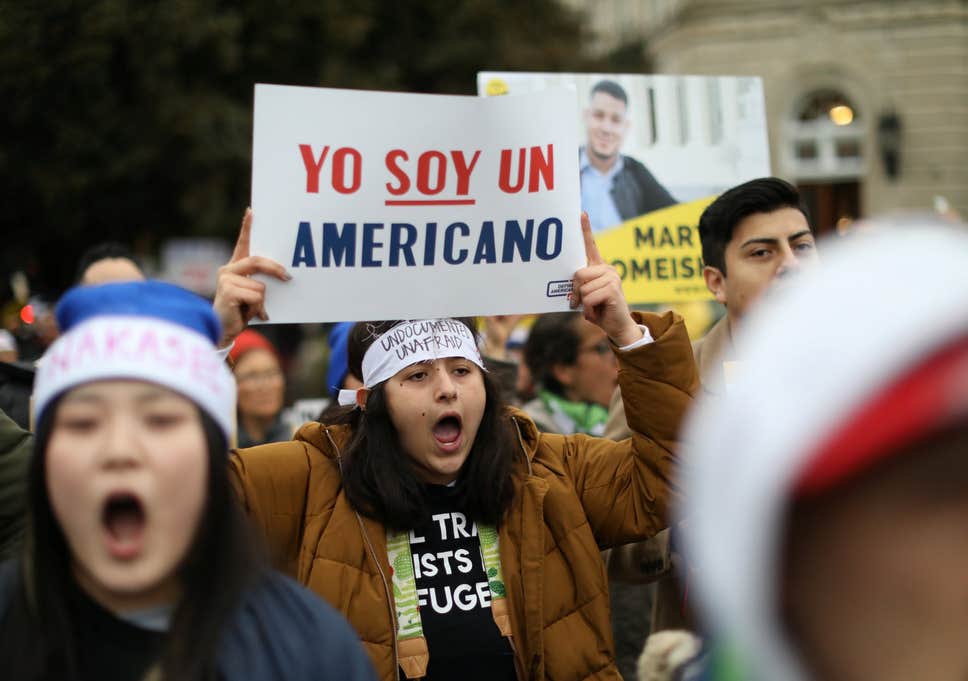
DACA illegal aliens protesting for permanent t amnesty. Photo: The Independent.

Center for Immigration Studies

Janet Napolitano’s DACA memorandum states that DACA is an “exercise of our prosecutorial discretion”..Prosecutorial discretion is not judicially reviewable.”

What Is DACA?

Is it a rule or is it prosecutorial discretion?

By John Miano on November 15, 2019I previously wrote about how the elite media has totally ignored the legal issues in its coverage of the DACA case before the Supreme Court. I thought I would fill in some of the gaps left by the press’s gross malpractice here. My only real interest in DACA is over the alien employment issue. However, more mundane issues of administrative law are likely to dominate the Supreme Court’s opinions.

A key question for the Supreme Court is “What is DACA?” The New York Times answers that question this way:

The program was introduced in 2012 by President Barack Obama as a stopgap measure that would shield from deportation people who were brought into the United States as children. The status is renewable, lasting two years at a time. The program does not provide a pathway to citizenship.

Participation in the program comes with a range of benefits. Along with permission to remain in the country, recipients can also get work permits, through which many have obtained health insurance from their employers.

To make this description complete, one needs to add that the alien has to file an application and pay a $495 fee.

In any event, this describes what DACA does, not what DACA is. So what is DACA? The answer to that question should drive the case, but the parties have tried to avoid the issue.

Janet Napolitano’s DACA memorandum states that DACA is an “exercise of our prosecutorial discretion”.

Prosecutorial discretion is integral to our system of law. Assume you are riding a crowded bus in Florida and you need to get past someone in order to get off. So you tap that person lightly on the shoulder to attract their attention. In doing so you have committed the crime of battery and could go to jail absent prosecutorial discretion not to prosecute such cases. At the same time discretion can be abusive, as in the Jeffrey Epstein matter.

If DACA is an exercise of prosecutorial discretion, the case before the Supreme Court is simple. Prosecutorial discretion is not judicially reviewable. Faced with that established law, the University of California argued before the Supreme Court that when the prosecutorial discretion involves a large number of people it becomes reviewable. Justices Alito and Gorsuch (twice) asked the obvious question: What rule should the Supreme Court adopt to distinguish between prosecutorial discretion that is not reviewable and that which is. The answers were:

It’s a composite — in this case, it’s a composite of principles, a determination that — a categorical determination involving a substantial number of people …

and

Well [] — there — as I said, it’s a combination of factors which include the government inviting people to rely upon and make decisions based upon that policy, the provision of benefits connected with it, individuals making choices, and — and then — and the Heckler case — [] specifically.

These are non-answers. It is surprising the University of California did not prepare a proposed rule for the court to adopt.

Going back to Napolitano’s original memo, it states:

This memorandum confers no substantive right, immigration status or pathway to citizenship. Only the Congress, acting through its legislative authority, can confer these rights. It remains for the executive branch, however, to set forth policy for the exercise of discretion within the framework of the existing law.

The memo from John Morton, director of ICE, ordering the implementation of DACA in his agency said:

As there is no right to the favorable exercise of discretion by the agency, nothing in this memorandum should be construed to prohibit the apprehension, detention, or removal of any alien unlawfully in the United States or to limit the legal authority of DHS or any of its personnel to enforce federal immigration law. Similarly, this memorandum, which may be modified, superseded, or rescinded at any time without notice, is not intended to, does not, and may not be relied upon to create any right or benefit, substantive or procedural, enforceable at law by any party in any administrative, civil, or criminal matter.

Napolitano as plaintiff argues that DACA created reliance on the program while her memo directing the creation of the program disclaims that is creates anything to be relied on and ICE made it clear that DACA could be rescinded at any time. (I refer to the respondents as the plaintiffs because that usage is likely clearest to most readers.)

At this point, it is time to stop calling a “spade” a “gardening tool”. DACA is not an exercise in prosecutorial discretion and Napolitano’s DACA memo was just a subterfuge. To participate one has to file an application. One has to file a $495 fee. DACA has a two-year duration. One gets a work authorization. DACA does not reflect the agency looking at individual cases and deciding whether they should be prosecuted.

The chief justice picked up on exactly that:

the whole thing was about work authorization and these other benefits. Both administrations have said they’re not going to deport people. So the deferred prosecution or deferred deportation, that’s not what the focus of the policy was. Yes, the other statutes provided that, but it was triggered by — by the memo.

The University of California correctly notes that the employment under DACA came from “under other unchallenged laws [i.e., regulations]”.

Indeed, that is because neither party had any incentive to question whether the regulations granting work authorizations were lawful. DACA recipients were never going to argue that the regulations that allowed them to work were unlawful. The immigration bureaucracy within DHS was not going to question whether its own regulations were lawful. When several states challenged the related DAPA program, the ability to confer work authorizations was addressed in an adversarial context.

This issue is one where amicus briefs stepped in. Four of the seven supporting the government raised the employment authorization issue that the government had neglected to raise. (See here, here, here, and my own, here.)

Unless the Supreme Court changes the rule that agency enforcement discretion is not judicially reviewable, the DACA rescission cannot be reviewed.

In any event, to be reviewed for being arbitrary and capricious, it has to be a reviewable agency action. That means a rule, order, license, sanction, relief, or the equivalent or denial thereof, or failure to act.

Logically, the rescission of DACA has to be the same type of agency action that created it. If it is not, that opens another string of legal argument beyond what I can address here. To that end, the courts below rejected the argument that the DACA program, created without notice and comment, had to be rescinded with notice and comment.

Which of these is the DACA? We know it is not a failure to act. License and sanction are easy ones to take off the table. An order means “a final disposition” so that one can go as well. Relief is a:

(A) grant of money, assistance, license, authority, exemption, exception, privilege, or remedy;

(B) recognition of a claim, right, immunity, privilege, exemption, or exception; or

(C) taking of other action on the application or petition of, and beneficial to, a person.

The granting of a DACA application could be relief but does not describe the DACA program.

That leaves a rule, which is:

The whole or a part of an agency statement of general or particular applicability and future effect designed to implement, interpret, or prescribe law or policy or describing the organization, procedure, or practice requirements of an agency and includes the approval or prescription for the future of rates, wages, corporate or financial structures or reorganizations thereof, prices, facilities, appliances, services or allowances therefor or of valuations, costs, or accounting, or practices bearing on any of the foregoing.

If we call DACA a “rule”, which is certainly its most accurate description, that creates a whole new set of issues. The courts differentiatebetween substantive rules and interpretive rules.

Read the rest here.


Filed Under: Immigration Research Archives

Another scandal for the hate-mongers – ‘Slave Wages’: Union Leader Says SPLC Retaliates Against Unionizing Employees

November 15, 2019 By D.A. King

Image: Fake News Exposed

‘Slave Wages’: Union Leader Says SPLC Retaliates Against Unionizing Employees

PJmedia.com

People are underpaid to the point they can’t earn a living making $20,000, $30,000 a year,” Jett said. “You’re talking about an organization with a half-billion dollar endowment. And they’re paying people slave wages

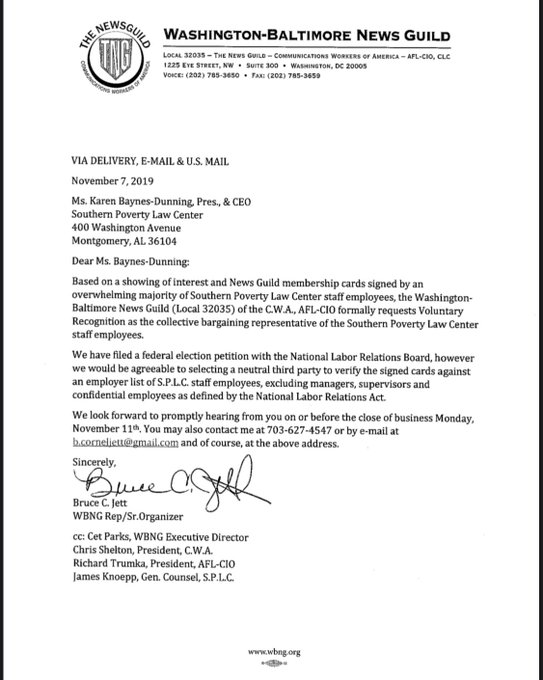
The Southern Poverty Law Center (SPLC), a far-left smear factory that routinely exaggerates the threat of “hate groups” in America for fundraising and political warfare purposes, is still recovering from a devastating sexual harassment and racial discrimination scandal that cleaned out the organization’s leadership in March. Michelle Obama’s former chief of staff, Tina Tchen, is still reviewing the organization’s workplace culture and employees want to form a union. The SPLC is fighting this effort, and one union leader even suggested the group had retaliated against organizers.

Bruce Jet, an organizing director and local representative for the Washington-Baltimore News Guild Local 320235, under which SPLC employees are organizing, told the Montgomery Advertiser that the SPLC, which has an endowment of half-a-billion dollars, pays its workers “slave wages.”

“People are underpaid to the point they can’t earn a living making $20,000, $30,000 a year,” Jett said. “You’re talking about an organization with a half-billion dollar endowment. And they’re paying people slave wages.”

Employees have long complained about a top-down workplace culture. “Above a certain level, the upper management is incompetent,” a former employee wrote in March 2018. “They treat non-lawyers like objects and don’t care for feedback or criticism. People are afraid to criticize upper management. Office culture is neglected and thus, turnover is high.”

The SPLC Union filed paperwork with the National Labor Relations Board last week, the Advertiser reported.

“We hope to rekindle the flame of labor organizing in the Deep South and form a strong union at the SPLC that lays the foundation for a legacy of equal rights, respect, and dignity for all workers, regardless of race, color, religion, sex, sexual orientation, gender identity, physical ability, ad national origin,” the union statement said.

SPLC Union@SplcUnion

In a momentous move, staff @splcenter — a historic Civil Rights organization advancing social justice through legal, educational and advocacy work primarily in the Deep South — are forming a union. #UnionizeTheDeepSouth

View image on Twitter
Read the rest of the story on the latest SPLC scandal here.


Filed Under: Recent Posts Achrives

Can Immigration Solve the Problem of an Aging Society? (Not so much)

November 14, 2019 By D.A. King

Photo: Miami University

“…we roughly estimate that 32 percent (13.8 million) of the people immigration has added to the country since 1990 are illegal immigrants or their progeny.”

Center for Immigration Studies

July 201By

Steven A. Camarota and Karen Zeigler

We estimate that immigration between 1990 and 2017 added nearly 43 million people to the population, but had a minimal impact on the share of the population that is of working age. This is because immigration added to both the working-age population and to those outside of the working-age population in nearly equal proportions. We also find that post-1990 immigration had a somewhat larger impact on the ratio of workers to retirees. However, raising the retirement age by one year has as large an impact on the ratio as do the nearly 43 million post-1990 immigrants and their progeny.

Among the findings:

  • In 2017, there were 30.8 million post-1990 immigrants (legal and illegal) and 12 million of their U.S.-born children and grandchildren in the country — 42.8 million in total, or one in eight U.S. residents.
  • The 42.8 million people post-1990 immigration (legal and illegal) added to the country is larger than the combined population of 22 states.
  • While adding significantly to the population, the presence of post-1990 immigrants and their progeny only increased the working-age (16-64) share of the population from 63.9 percent to 64.4 percent in 2017.
  • Immigration had a small impact on the working-age share because immigrants arrive at all ages, grow older over time, and have children, so they added to both the working-age and those too old or too young to work in nearly equal proportions.
  • Even if the number of post-1990 immigrants and their offspring was doubled to almost 86 million, about one in four residents, it would still only have raised the working-age share to 64.8 percent — 0.9 percentage points higher than if there had been no immigration.
  • The working-age share can be seen as the best way to think about the ability of society to pay for government or support the economy, as both children and the elderly generally do not work and are supported by the labor of others.
  • Excluding children, and looking only at the number of working-age people (16-64) relative to those of retirement age shows that post 1990-immigration increased the ratio from 3.7 potential workers per potential retiree to 4.1.
  • If the retirement age were raised by just one year, assuming no immigration, the ratio of workers to retirees would be 4.1, matching the effect of post-1990 immigration.
  • Increasing the retirement age by two years, assuming no post-1990 immigration, would have increased the worker to retiree ratio to 4.5 in 2017. It would have required doubling post-1990 immigration to nearly 86 million to match this effect.
  • In terms of using immigration as a way to pay for entitlement programs, it must also be pointed out that a large share of post-1990 immigrants and their children struggle, living in or near poverty and using welfare programs at relatively high rates. This makes it difficult for them to generate a fiscal surplus that can pay for social insurance programs.
  • In 2017, 45 percent of households headed by post-1990 immigrants or their adult children used one or more major welfare programs, compared to 26 percent of native-headed households. The rates of poverty or near poverty for post-1990 immigrants and their children were 50 to 60 percent higher than that of natives.
  • While this analysis is focused on all immigrants (legal and illegal), we roughly estimate that 32 percent (13.8 million) of the people immigration has added to the country since 1990 are illegal immigrants or their progeny. Since legal and illegal immigration together have a modest impact on the working-age share or the worker-to-retiree ratio, the impact of illegal immigration by itself is very small.

Steven A. Camarota is the director of research and Karen Zeigler is a demographer at the Center.

Much more here.


Filed Under: Immigration Research Archives

Criminal Arrest Histories of illegal alien DACA Applicants: USCIS

November 13, 2019 By D.A. King


DACA illegal aliens protest in front of U.S. Supreme Court, November 12, 2019. Image: Harper’s Bazaar
From USCIS
New Data Shows Criminal Arrest Histories of DACA Requestors

WASHINGTON—U.S. Citizenship and Immigration Services (USCIS) released new data (PDF, 140 KB) regarding arrests and apprehensions among the Deferred Action for Childhood Arrivals (DACA) requestor population. The data contains both criminal and civil information of those approved and denied under DACA.

The findings are part of a continuous release of information by the agency to its website on both the DACA policy and its requestor population; including most recently, data regarding ages and education levels of DACA recipients. The new data relates to arrests and apprehensions, which do not necessarily result in actual convictions.

Among the findings of the release:

  • Almost 8-percent of total DACA requestors (59,786 individuals) had arrest records as of the date the systems were queried, which included offenses such as assault and battery, rape, murder, and drunk driving, among others.  “Requestors” includes individuals approved and denied DACA.
  • Of those individuals whose DACA requests were approved and had one or more arrests or apprehensions, 53,792 were arrested or apprehended prior to their most recent approval.
  • Approximately 13-percent (7,814) of approved DACA requestors with an arrest had an arrest after their grant was approved and prior to renewal.
  • 54.8-percent of DACA requestors with more than one arrest (17,079) most recently had a DACA case status of “approved” as of the date the systems were queried.
  • 199 individuals who requested DACA had 10 or more arrests. Of those, 51 most recently had DACA case status of “approved,” as of the date the systems were queried.
  • Of the total 888,765 DACA requestors, 797,297 had no arrests or apprehensions, and 710, 842 were approved.

“In striving for transparency, USCIS has released a variety of information on both the DACA policy and its population as part of a continued effort to keep the public informed. As such, criminal activity of DACA requestors has long been the subject of widespread discussion and speculation, with a regrettable lack of available data until now. The truth is that we let those with criminal arrests for sexually assaulting a minor, kidnapping, human trafficking, child pornography, or even murder be provided protection from removal. Yet the courts rule that we are unable to change this policy – even though those with criminal histories are getting through the system and permitted to remain in the country, despite having a high number of arrests for any types of crimes before or after receiving DACA protection,” said USCIS Director L. Francis Cissna.

“There are legitimate concerns over a portion of the population who have requested, and been granted, the privilege of a temporary stay of their removal under the illegal DACA policy. Until it can be repealed, this criminality data only reinforces the need for its continued review and scrutiny, which was imposed unilaterally by the Obama administration in circumventing Congress. It’s our hope that it helps the public and policy makers better understand the reality of the entire DACA population,” Cissna added.

Under current DACA policy, an individual may be considered for DACA if he or she has not been convicted of a felony, significant misdemeanor, or three or more “non-significant” misdemeanors not arising out of the same act, omission, or scheme of misconduct, or does not otherwise pose a threat to national security or public safety. Numbers of arrests alone do not necessarily disqualify a person from receiving DACA as a matter of discretion.


Last Reviewed/Updated: 06/18/2018 Here.

Filed Under: Immigration Research Archives

VIDEO Bernie Sanders on open borders – before his latest amnesty proposal that looks a lot like open borders

November 8, 2019 By D.A. King

Bernie Sanders used to say that open borders was a Koch Brothers proposal… But his new immigration plan looks a lot like open borders.https://t.co/aHKZEtRMg6 pic.twitter.com/czys7fyXn6

— NumbersUSA (@NumbersUSA) November 8, 2019

Filed Under: Immigration Research Archives

Fast Fact: 67.3 million residents in the United States now speak a language other than English at home, a number equal to the entire population of France

November 7, 2019 By D.A. King

Image: Twitter

Of those who speak a foreign language at home, 45 percent were born in the United States

The number has nearly tripled since 1980, and more than doubled since 1990. The growth at the state level is even more pronounced. All language figures in Census Bureau data are for persons five years of age and older.

Among the findings:

  • In 2018, a record 67.3 million U.S. residents (native-born, legal immigrants, and illegal immigrants) spoke a language other than English at home. The number has more than doubled since 1990 and almost tripled since 1980.
  • Since 1980, the number who speak a foreign language at home grew nearly seven times faster than the number who speak only English at home. Even since 2010, when the number speaking a foreign language at home was already very large, the number of foreign-language speakers increased more than twice as fast as that of English speakers.1
  • As a share of the population, 21.9 percent of U.S. residents speak a foreign language at home — more than double the 11 percent in 1980.
  • In nine states, more than one in four residents now speaks a language other than English at home. These nine states account for two-thirds of all foreign-language speakers. In contrast, in 1980 foreign-language speakers were one in four residents in just two states (New Mexico and Hawaii); and these two states accounted for just 3 percent of all foreign language speakers.
  • The states with the largest share of their populations speaking a foreign language at home in 2018 were California (45 percent), Texas (36 percent), New Mexico (34 percent), New Jersey (32 percent), New York and Nevada (each 31 percent), Florida (30 percent), Arizona and Hawaii (each 28 percent), and Massachusetts (24 percent).
  • States with the largest percentage increase in those speaking a foreign language at home from 1980 to 2018 are Nevada (up 1,088 percent), Georgia (up 952 percent), North Carolina (up 802 percent), Virginia (up 488 percent), Tennessee (up 459 percent), Arkansas (up 445 percent), Washington (up 432 percent), South Carolina (up 398 percent), Florida (up 393 percent), Utah (up 383 percent), and Oregon (up 380 percent).
  • States with the largest percentage increase in the number of those speaking a foreign language at home since 2010 are North Dakota (up 63 percent), Utah (up 29 percent), Iowa (up 24 percent), Florida, Minnesota, Oklahoma, Washington, Maryland and Nevada (each up 23 percent), Oregon and Tennessee (each up 22 percent), North Carolina and Kentucky (each up 21 percent), and South Carolina (up 20 percent).
  • In America’s five largest cities, just under half (48 percent) of residents now speak a language other than English at home. In New York City it is 49 percent; in Los Angeles it is 59 percent; in Chicago it is 36 percent; in Houston it is 50 percent; and in Phoenix it is 38 percent.2
  • In 2018, there were 90 cities and Census Designated Places (CDP) with populations of at least 63,000 in which a majority of residents spoke a foreign language at home. These include Hialeah, Fla., and Laredo, Texas (each 89 percent); East Los Angeles (88 percent); and Passaic, N.J. (78 percent).3
  • In 2018, there were 229 cities and CDPs in which more than one in three residents spoke a language other than English at home. Some of these places may be surprising: Providence, R.I. (50 percent); Allentown, Pa. (48 percent); Germantown, Md. (46 percent); Centerville, Va. (44 percent); New Rochelle, N.Y. (42 percent); West Valley City, Utah (39 percent); Springdale, Ark. (35 percent); and Troy, Mich. (34 percent).
  • The largest numerical increases in those who speak a language other than English at home between 2010 and 2018 were among speakers of Spanish (up 4.5 million), Chinese (up 663,000), Arabic (up 394,000), Hindi (up 265,000), Tagalog (up 187,000), Telugu (up 177,000), Vietnamese (up 161,000), Bengali (up 152,000), Portuguese (up 128,000), and Tamil (up 124,000). Telugu and Tamil are spoken in India, Tagalog is the national language of the Philippines, and Bengali is spoken in India and is also the national language of Bangladesh.
  • Languages with more than a million people who speak it at home in 2018 were Spanish (41.5 million), Chinese (3.5 million), Tagalog (1.8 million), Vietnamese (1.5 million), Arabic (1.3 million), French (1.2 million), and Korean (1.1 million).
  • There are now more people who speak Spanish at home in the United States than in any country in Latin America with the exception of Mexico, Colombia, and Argentina.
  • Of those who speak a foreign language at home, 25.6 million (38 percent) told the Census Bureau that they speak English less than very well. This figure is entirely based on the opinion of the respondent; the Census Bureaus does not measure language skills.4
  • From CIS here.


Filed Under: Fast Facts Archives

  • « Go to Previous Page
  • Page 1
  • Interim pages omitted …
  • Page 54
  • Page 55
  • Page 56
  • Page 57
  • Page 58
  • Interim pages omitted …
  • Page 74
  • Go to Next Page »

Primary Sidebar

 “Journalism is printing what someone else does not want printed: everything else is public relations.” Attributed to George Orwell.

miss something? see Post Archives and fast facts archives here

Categories

Brian Kemp
Photo: mdjonline.com

#BigTruckTrick

Days since GA Gov. Brian Kemp promised action on 'criminal illegals,' sanctuary cities, a criminal alien registry and related legislation:

2708

The Southern Poverty Law Center: Part Karl, Part Groucho

An Illegal Alien in Georgia Explains How To Drive Illegal Aliens Out of Georgia – SB529, 2007

https://youtu.be/oxe1WO27B_I

Gwinnett County, GA Sheriff Kebo Taylor and state law


About the author (click photo)

DA King

Foreign cops & lower college tuition for illegals than Americans, anyone? *Complete coverage of GA. House Study Committee “Innovative Ways to Maximize Global Talent”

ANSWERING THE SMEARS AJC/SPLC

Answering the smear: “blow up your buildings…” How a lie passed on by the AJC in 2007 is still being used against D.A. King (me)

FOREVER 16: REMEMBER DUSTIN INMAN

The Southern Poverty Law Center – a hate mongering scam

https://youtu.be/qNFNH0lmYdM

IMMIGRATION & WORLD POVERTY – GUMBALLS

https://youtu.be/LPjzfGChGlE?t=1

       CATO INSTITUTE: OPEN BORDERS

Georgia is home to more illegal aliens than green card holders

More illegal aliens than lawful permanent residents (green card holders) Image: GBPI.org

On illegal immigration and Georgia’s higher-ed system

Illegal aliens protest to demand "equity." Image: Twitter

Footer

Follow these immigration experts on Twitter

Follow these immigration experts on Facebook

contact georgia state legislators

State House Reps and state senators – contact georgia state legislators here.

If you don’t know who represents your and your family in Atlanta, you can find out here.

Contact the Georgia Delegation in Washington

Contact info for the Georgia delegation in Washington DC here. Just click on their name.

Copyright © 2026