• Skip to primary navigation
  • Skip to main content
  • Skip to primary sidebar
  • Skip to footer
  • Home
  • DIS blog
  • Definition of terms – DHS
  • Birthright Citizenship
  • Contact us

Immigration Politics Georgia

looking for a better life • news and pro-enforcement opinion

  • Illegal Alien Lobby
  • georgiafornia
  • SPLC
  • report illegal aliens/illegal employers
  • Fast Facts from the original DIS blog

Search Results for: sb 264

Correction on false information on SB 264 from Sen Mike Dugan is MIA

October 13, 2023 By D.A. King

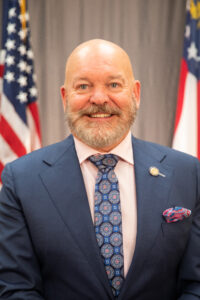
Senator Mike Dugan. Contact:121-F State Capitol
Atlanta, GA 30334
Office: (404) 656-7872
District Address
PO Box 1260
Carrollton, GA 30112
Email: (contact form)

In addition to being grateful to editor/publisher Sue Horn for the space to write here about illegal immigration in Georgia, I am also a Star News reader. As such, it seems there was something glaringly absent from the previous three editions of this newspaper. I am very curious to know if other readers agree.

I was looking for and expected a correction from Republican Senator Mike Dugan. Was anyone else?

In the June (print) edition of Star News, I wrote about a Democrat bill pending under the Gold Dome that deals with changing a law that effects tuition costs in our public-funded colleges and the definition of “resident” used to determine eligibility for instate tuition. SB 264 is a Democrat bill on which Sen. Dugan is the number one cosponsor.  The headline over my column then was “SB 264: Americans last college tuition legislation” which reflects my view of the bill.

My experienced opinion is based on the language in the legislation and understanding what would happen if it became law.

Here is that exact wording with my own emphasis on what I regard as the “Americans last” part: “noncitizen students admitted to the United States as refugees pursuant to 8 U.S.C. Section 1157; as special immigrants pursuant to Public Law 110-181, Section 1244, as amended, Public Law 109-163, Section 1059, as amended, or Section 602(b) of Title VI of Division F of Public Law 111-8, as amended; or as humanitarian parolees pursuant to 8 U.S.C. Section 1182(d)(5)(A) shall be classified as in-state for tuition purposes immediately upon settlement in Georgia; provided, …”

Simply put for people who don’t read and work with state legislation on a regular basis, SB 264 says that “special immigrants” (known as “SIVs”) and otherwise illegal aliens who are granted Biden’s ‘humanitarian parole’ to legally enter the U.S. could migrate to Georgia and be eligible for the much lower instate tuition rate in our public colleges the same day they arrive.

The bill would alter current state law that requires all new Georgia residents to live here for a year before they are allowed to access the instate tuition rate. That “all” description includes the above foreigners as well as Americans who move here from other states.

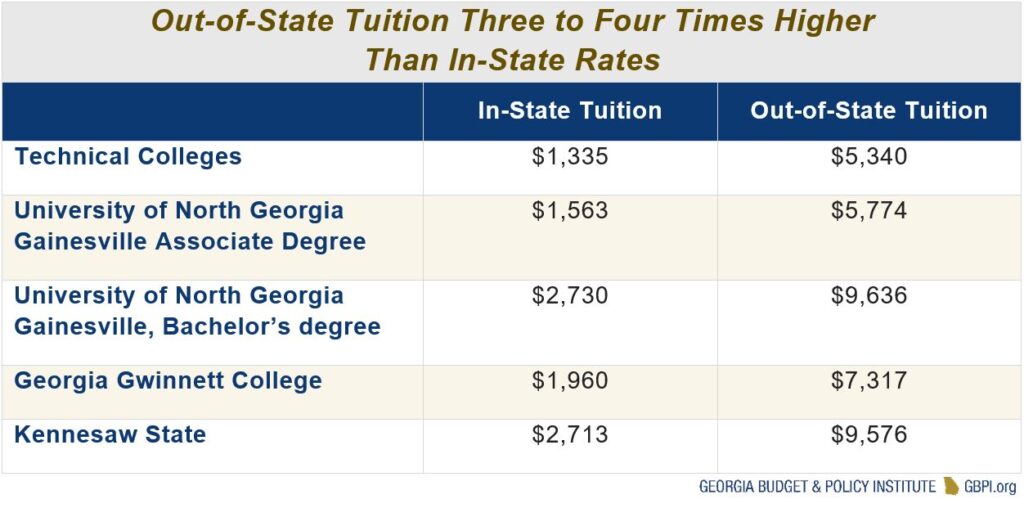
The current instate tuition at West Georgia College is $2,732 (15+ hours). The current out-of-state tuition is $9,641 (15+ hours) per semester (westga.edu).

As I wrote, SB 264 does not change the fact that an American student from Michigan (for example) would still have to wait twelve months to qualify for the lower tuition while it allows a new student from Afghanistan to qualify upon arrival.

Sue Horn, the Star News editor quite correctly passed my column on to Sen. Dugan before the June edition deadline so that he could respond to my opinion of the bill on which he is a cosponsor in the same (June) edition. His reply ran directly below my space. But it was full of numerous obvious, easily refuted inaccuracies.
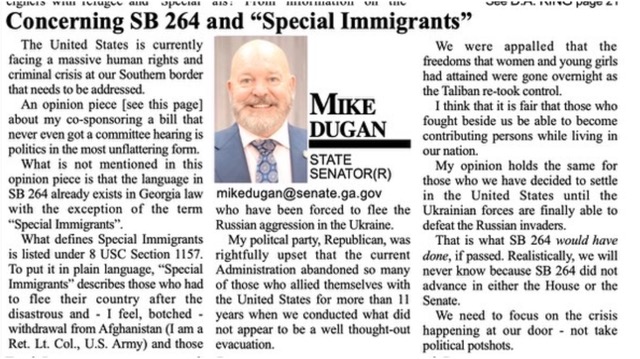
Just two examples:

  • Dugan told readers here that the bill “…never even got a committee hearing…” The fact is that I watched the March 16, 2023 Senate Higher Education Committee hearing on SB 264 myself. There was no vote. I posted a link to that meeting with a video of the hearing and a transcript of the proceedings on my website.
  • Dugan also told readers – and constituents – that “the language in SB 264 already exists in Georgia law with the exception of the term “Special Immigrants.” It doesn’t. Again, SB 264 eliminates the existing law that says the “Special Immigrants” and humanitarian parolees must live here a year before qualifying for instate tuition – just like Americans do.

The July Star News edition contained my point-by-point explanation of those false statements along with references and citations that illustrate the truth. Ms. Horn headlined it “Pending legislation creates a benefit and significant monetary savings for foreign nationals that is not available to Americans.”

Readers who want to review all of this can access these columns on ImmigrationPoliticsGA.com by entering “Mike Dugan” in the search bar. Please be reminded that despite what Sen Dugan wrote in June, SB 264 is quite alive and viable in the state Capitol for next year.

There has been no correction or explanation from Senator Dugan (contact info) in the editions of this newspaper that were published after his June rebuttal column. I checked with Ms. Horn to be sure I had not missed something. I also contacted Sen Dugan asking for any input he wanted to offer for this article but as I write on deadline on October 3rd, I have not received a reply.

So, I’ll end where I began on top. Did any other readers think they were owed a correction or explanation of any of this from Senator Dugan? I would like to hear from you either way.

It would be a shame if voters were not paying attention or are somehow timid enough to ignore the unapologetic, outrageously erroneous statements on Democrat legislation from a Republican state senator in their community newspaper.

  • A version of this column is also published in the October 15, 2023 print edition of the (Carroll County) Star News.
Filed Under: Recent Posts Achrives

‘Americans last’ tuition bill: Sen. Mike Dugan’s response to my Star News column on SB 264 and a fact check

June 12, 2023 By D.A. King


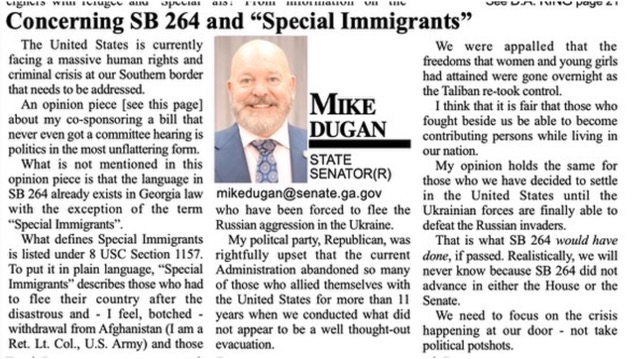
Last week Insider Advantage posted my column on the pending instate tuition bill, SB 264 and its Republican cosponsors. A version of the column was later published in the June 11, 2023 edition of the (Carroll County) Star News (there is another version here. Also a post on the bill with more information here). The Star News editor also published a reply from SB 264 cosponsor Sen. Mike Dugan below my column in which he makes some astoundingly inaccurate claims in defense of his support for the legislation. As there is not yet a dedicated link to Senator Dugan’s Star News response, I post a screen shot of his reply below.

June 11, 2023 edition Carrol County Star News, page 17.


My fact-check reply to Sen Dugan’s response:

  • Senator Dugan writes that “the bill never even got a committee hearing.”

The reality is that the Senate Higher Education Committee held a hearing on the bill on March 16, 2023. I watched it. The link to archived video, transcript, and a photo from that meeting is here.

  • Senator Dugan: “…the language in SB 264 already exists in Georgia law with the exception of the term “Special Immigrants.”

We ask that Sen. Dugan cite that language in Georgia law.

Senate Bill 264 amends state law to read that “…refugees, special immigrants and humanitarian parolees shall be classified as in-state for tuition purposes immediately upon settlement in Georgia;” This would remove the existing 12 month residency requirement for that group of foreign nationals. It would not do the same for Americans. Please see lines 17 – 23. This language is not in existing state law.

We advise all concerned to read the explanation of the bill from its originators when it was numbered HB 932 in 2022. That attempt failed when the House Higher Education Committee chairman declined to advance the bill.

Sen Dugan is correct that the measure would add the term “special immigrants” (known as “SIVs”) to the code, but SIVs already have Lawful Permanent Residence status. And OCGA 20-3-66  (3) (e) –  (and Board of Regents policy 4.3.2.3) – already grants individuals with LPR status “the same consideration as citizens of the United States in determining whether they qualify for in-state classification.”

  • Senator Dugan in his reply column: “What defines Special Immigrants is listed under 8 USC 1157.”

Reality: 8 U.S. Code § 1157  deals with refugees as is made clear in the law’s caption: “Annual admission of refugees and admission of emergency situation refugees.” Refugees are not SIVs. “Refugee” is defined in multiple links throughout the federal law as posted here.

SIVs are defined and created in federal laws cited in the language of the bill (lines 18-22).

 More on special immigrants (SIVs) here

  • Sen Dugan writes that that the term “Special Immigrants” includes “…those who were forced to flee the Russian aggression in the Ukraine.”

 Actually, some Ukrainians are allowed to enter the U.S. under Humanitarian Parole status (a good explanation here) and some have received Temporary Protected Status (TPS). TPS is not SIV. Neither is Humanitarian Parole.

  • Senator Dugan: “I think that it is fair that those who fought beside us be able to become contributing persons while living in our nation.”

Fine. Very noble. But the Democrat legislation Sen Dugan has put his name on and is pushing creates a benefit and significant monetary savings for foreign nationals that is not available to Americans in their own country. And he is wildly inaccurate in his defense of that decision.

     Related: Refugee Resettlement Fraud in the Program for U.S.-Affiliated Iraqis – A repeat scenario with Afghan nationals?

  • On SB 264 Sen Dugan writes: “This is what SB 264 would have done if passed. Realistically we will never know because SB 264 did not advance in the House or the Senate.”

This is another head-shaker. It is difficult to understand this statement. SB 264 was dropped in the Senate hopper on February 27, 2023. While it had a hearing (without a vote) after Crossover Day, it can still easily advance. Because the Georgia General Assembly operates on a biennial system, legislation that didn’t pass will be carried over to the second half of the biennial General Assembly starting January 8 2024. Realistically the legislation is quite viable for the 2024 session.

________

Notes.

From information on the University of West Georgia website we see that the instate tuition rate at UWG is $2186.00 (12 credit hours) vs the out-of-state cost of $7712.00 per semester.

 Ga. Code § 20-3-66

Section 20-3-66 – Determination of in-state resident status of students for tuition or fees

(b)(1)

“An independent student who has established and maintained a domicile in the State of Georgia for a period of at least 12 consecutive months immediately preceding the first day of classes for the term shall be classified as in-state for tuition purposes.”

A quick look at the Board of Regents webpage on instate tuition eligibility illustrates the same truth: ”…lawful permanent residents, refugees, asylees, or other eligible noncitizens may be extended the same consideration as citizens of the United States in determining whether they qualify for in-state classification.” Because they have LPR status, this already includes SIV recipients.

Filed Under: Recent Posts Achrives

Transcript: Senate Higher Education committee hearing on SB 264, March 16, 2023

June 6, 2023 By D.A. King

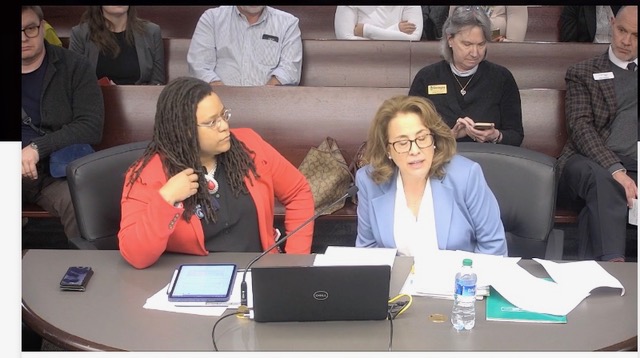
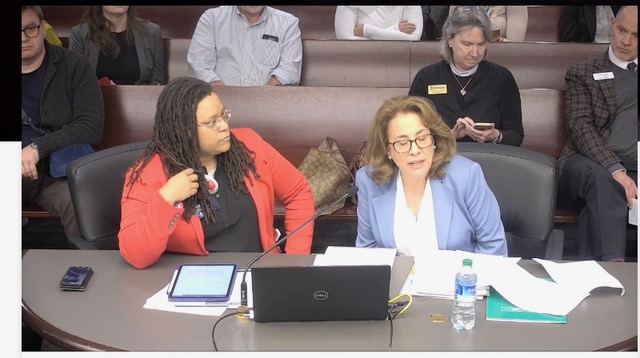
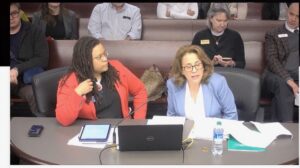
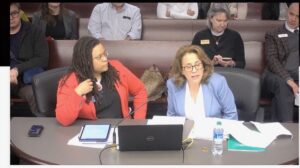
Democrat Sen. Kim Jackson and Darlene Lynch from ‘Business & Immigration in Georgia’ coalition present SB 264. Senate Higher Ed, committee, March 16, 2023.

Transcript by Rev.com from Senate video.

Begin bill presentation in Senate Higher Education committee, March 16, 2023:

_

Sen. Kim Jackson (D- bill sponsor)

Uh, and we were working off of Senate bill 264, which is LC500510.

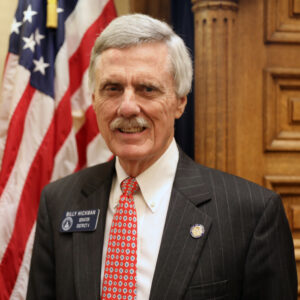
Senate Higher Ed committee Chairman, Sen. Billy Hickman

You’re totally good.

Sen Jackson:

All right, thank you. And I- I want to begin by thanking the chairman for allowing us to have this hearing. This is, um, such an important conversation for us to begin. And so, um, as you can see from the sign that was there, uh, many people who are very much interested and invested in this issue. Um, so very briefly, what this bill does is that it allows people who are resettled here in Georgia via a special immigration status, so what we’re talking about specifically are people who served, um, and helped our military in Afghanistan. Um, people who have been, um, clearly on our side when it’s come to those wars.

They’ve come here with special immigrant status and this bill would allow them to receive in-state tuition, uh, upon being resettled here. I think it’s important to note that none of those folks that have come here have come from another state. They don’t have another state where they could get in-state tuition, right? Oftentimes, this is what we’re thinking about. We’re like, “Oh, we don’t want somebody who lives in South Carolina, say, um, where they could get in-state South Carolina tuition, we don’t want them coming to Georgia and getting our in-state tuition.”

For people who come here who are resettled by our federal government, folks who have been our friends, who have gone through extreme amounts of trauma and yet still been dedicated to, uh, this country, people who are resettled here, this is their home state. This is in-state for them. And so, this bill would allow those who have a Humanitarian Parole status, a special immigrant status, to be able to continue their education and to do that in a way that’s affordable by receiving in-state tuition. If, with that, there are a lot of people who signed up. And so I- I’m happy to yield as much time, um, to them, if that would be helpful, Mr. Chairman.

Chairman Hickman:

Can I ask a, ask a quick question?

Sen. Jackson

Oh, please.

Chairman Hickman:

Um, uh, s- I think, um, maybe Senator Payne and I had a conversation about Dalton, Georgia, and, you know, the Hispanic population, adult and- and- and so forth, and the parents of refugees, but children… I guess the children are also refugees in the school system out there. And [inaudible 00:02:27] when they graduate from the school system, they don’t qualify for in-state tuition. Is- is that a part of all this?

Sen Jackson:

So actually, that’s a separate bill, um, so, and- and one certainly that I hope many of us will support in the future. Um, so, ch- the children that you’re referring to, um, often have DACA status. So, um, they are children who- who came with parents of their own- no- no accord of their own, right? These children are… these young adults, these are, these are young adults or- or children, they’re coming here, um, with legal status from day one.

Um, they, on day one, uh, not only did they come here with legal status on day one, they were picked out, right, from Afghanistan, from the countries that they were, um, and recognized and acknowledged as having either assisted the US military a- as interpreters or, um, being people who are extreme in danger of being harmed because of their, um, support to the US military. So these folks arrived on day one with legal status in our state as a special immigrant, um, whereas the folks that you’re talking about don’t have legal status.


Chairman Hickman

Ok..[inaudible 00:03:35].

Sen. Jackson:

So this bill would be very clear, very specific, um, to folks with legal status to be here in the state, and this is their home.

Chairman Hickman:

Senator Payne?

Senator Chuck Payne:

Yes. Uh, this, would this apply to, um, my question is, ’cause I- I’m in the military, I- I remember we had a gentleman that was actually, uh, from Nicaragua, and he was serving in, next to us in the first 504th Second Airborne Division. And you know, was s- and I come to realize since then that we have a lot of noncitizens that are serving in our military. And so, would this… For those who are living here, this would allow them, if they were living in Georgia and states [inaudible 00:04:21] and for, that- that would bene- that would help those to access-

Sen. Jackson

I- I’m gonna bring my specialist here. I- I don’t think that’s accurate. I have a different bill, um, f- to allow those folks to become peace officers in our state. But, um, this is Darlene Lynch. She really is my expert who can answer that question definitively.

Senator Payne:

Okay, thank you.

Chairman Hickman,

So again, tell us who you are and-

Darlene Lynch – (Coalition of refugee Services (CRSA):

Sure.

Chairman Hickman:

… then who you represent.

Darlene Lynch:

I’m Darlene Lynch, and I’m a lawyer here in Georgia, and I represent the Business and Immigration for Georgia Partnership. It’s a partnership of, um, refugee and immigrant serving agencies in the business community, um, and so to answer your question, uh, as- as Senator Jackson said, it’s not possible to become eligible after you’re here. You have to be admitted to the United States as a special immigrant visa holder. So a- an interpreter from, um-

Senator Payne:

Oh…[inaudible 00:05:15].

Darlene Lynch:

… Nicaragua would not have that, w- would- would not have that ability. They’d have to be from Afghanistan or Iraq. However, if they were a Humanitarian Parolee, um, approved before coming to Georgia, yes. They- they’d be-

Senator Payne:

Okay. So this is specifically for those in Afghanistan and Iraq?

Darlene Lynch:

And for others who have Humanitarian Parolee, other special immigrant status.

Senator Payne:

Okay. Okay.

Darlene Lynch:

But it’s not something you can-

Senator Payne:

The reason I identified that, because this was [inaudible 00:05:42] Nicaragua was our [inaudible 00:05:44] (laughs).

Darlene Lynch:

[inaudible 00:05:46].

Senator Payne:

And that is always one of those questions that… He- he fled Nicaragua in a very t- tough time and- and joined the military to serve our country.

Darlene Lynch:

Mm-hmm.

Chairman Hickman:

Senator Moore.

Senator Colton Moore:

Uh, thank you, Mr. Chairman. So I’m just trying to understand what a special immigration status is.

Sen. Jackson:

Sure.

Senator Moore:

And, um, if I, if I read it off the US Citizenship and Immigration Services Homeland Security website, it says, “Special immigrant is a noncitizen who qualifies for a green card after meeting certain criteria. So, it doesn’t say anything about assisting the US or the state of Georgia, for that matter.

Sen Moore:

Do you want to [inaudible 00:06:27]?

Darlene Lynch:

So the… We’re… this bill addresses three categories of people: refugees, I think most folks are familiar with the US refugee program that dates back from the Vietnam War, and the Un- and Georgia’s program dates back four decades. Special immigrant visa holders are… There’s three programs that the US government have set up. The oldest program, they’re all referenced in the bill, would apply to interpreters from Iraq and from, um, Afghanistan who served as interpreters and translators for certain periods of time and applied for an SIV and then came here.

The more recent programs, there’s another one for Iraqis, and the most recent one for Afghans, who had supported or acted in a trusted role with the US government. They have to get approved by the- the head of mission, um, and then they apply for an SIV, uh, uh, permit. They wait many, many years, up to three years now, to get that. And then they come. So, all three of those SIV programs are for people who supported the US military or the US mission in those countries. And then the last program is for Humanitarian Parolees.

Sen Jackson:

And just to hopefully alleviate some of your concerns, we do spell out the exact code section in the federal law. If you look in lines, uh, 19, starting line 18 through 22. So we’re not, um, we’re not talking about just special immigrants, but we do specify the exact, um, types of special immigrants that, um, Ms. Lynch just a- Attorney Council Lynch just referred to.

Senator Moore:

Okay. Yeah, I’ll certainly have to go read those. Thank you, Mr. Chairman.

Chairman Hickman:

Okay. Senator Burns?

Senator Burns:

Um, thank you, Mr. Chairman. And- and, uh, thank you to the author and to those who support the legislation. I certainly support the concept. Uh, I think, um, it’s a, it’s worthy for us to acknowledge the service of those who’ve helped our country. A few quick questions. Are other states offering similar benefits? Could you, could you, uh, could you share that and kind of give me an idea of what other states might have chosen to do?

Sen Jackson:

Yes. So, uh, there are other states. Tennessee, um, specifically, uh, Council Lynch might be able to add some more. Um, so, some of this is about clarifying the law. If you, if you look there, um, there is a sentence, um, I’ll see if I can refer to the line, where the Board of Regents is given some opportunity to determine. So if you look at, um, I think line, uh, it started on line 12. 12 through 14, um, the Board of Regents has some leeway already written into the law, and so in other states like Tennessee, um, they’ve actually chosen to interpret, um, that those who come as Humanitarian Parolees, who come with these SIVs, that they’re, that they qualify.

They didn’t necessarily… They then interpreted that and decided to have that kind of generous read already. So I know that’s one example, if, uh, Councilor Lynch can offer more.

Darlene Lynch:

Right. And so, different states are doing it different ways, but right now, there are 10 states who passed similar legislations. And some of them include Colorado, V- Virginia, Ohio, Wisconsin, Vermont, both Democrat, Republican states, and now there are five pending, including in Utah as the most recent one. Um, similar legislation to this bill.

Senator Burns:

And thank you. Uh, another followup, Mr.- Mr. Chairman? Uh, how many students do you feel would be a part of this qualifying group?

Sen Jackson:

Yeah, thank you so much for that question, and- and that’s something we’re trying to kind of get a han- handle on. And we’re not, we’re not 100% sure. But we believe it’ll be somewhere in the hundreds. So two, three-

Senator Burns:

You said we’re talking hundreds, not thousands, probably?

Sen Jackson:

We’re not talking, we’re not talking thousands at all. We’re talking somewhere in the hundreds.

Senator Burns:

All right. And then one more. I apologize, Mr. Chairman. But, uh, have you had these discussions with USG and TCSG?

Sen Jackson:

Absolutely. And those s-

Senator Burns:

And are- are they… I- I would… Their response, how do they feel about it?

Sen Jackson:

We- we’re continuing in those conversations.

Senator Burns:

[inaudible 00:10:26].

Sen jackson:

So those discussions have been ongoing. Um, this legislation, I think the fact that we’re having this conversation, this is a bipartisan piece of legislation that many of you, um, on the majority side have signed on. Um, I think will help us in that conversation.

Senator Burns:

Yeah, yeah, it w- it would impact their tuition, but, uh, I recognize that, uh, um, the- they just need to be a part of the conversation. That’s all I ask.

Sen Jackson:

And- and they are. They absolutely are. Would you like to answer that?

Darlene Lynch:

No, [inaudible 00:10:51].

Sen Jackson:

Okay.

Senator Burns:

Thank you, Mr. Chairman.

Chairman Hickman:

Okay. Why- why don’t we bring the company speakers so that they would… Let them have about a minute and a half each.

Sen Jackson:

Excellent.

Chairman Hickman:

And so I’ll- I’ll let you choose.

Sen Jackson:

Um, do you have the list?

Chairman Hickman:

I do.

Sen Jackson:

Actually, I’ve got another list. Do you wanna pick?

Darlene Lynch:

Um, sure.

Sen Jackson:

Which, who’s gonna speak? I think if we have Yonas come first?

Darlene Lynch:

Yes. [inaudible 00:11:13].

Sen Jackson:

Yeah, did you want to testify? (laughs).

Darlene Lynch:

[inaudible 00:11:14].

Sen Jackson:

Well, we’ll begin with Darlene, and then we’ll have Yonas speak.

Darlene Lynch:

[inaudible 00:11:18].

Sen Jackson:

Where do you want them to testify from, Mr. Chairman?

Chairman Hickman:

Yeah?

Sen Jackson:

Where- where would you like… Do you want them to do it from here?

Chairman Hickman:

Oh, sure, right there. Yeah. Go ahead.

Sen Jackson:

Yeah? Yeah. Okay. I’ll switch with you (laughs).

Darlene Lynch:

Um, thank you all, and, uh, for the opportunity to share our support for this bill. Um, and thank you for the sponsors of this bill on this committee. Again, my name’s Darlene Lynch, chair of the Business and Immigration for Georgia Partnership. I want to, um, start by saying this bill arose out of months of work on the House side of a bipartisan study committee on how to maximize Georgia’s global talent. And what we recognized is that one in 10 Georgians is foreign born today. One-tenth of our population. Um, one-seventh of our workforce is foreign born. And yet we have so much talent that we have yet to tape.

And so the Global Talent Study Committee, um, looked at what are the barriers? How can remove the, we remove those barriers? And the number one recommendation was to address the barriers to admission to Georgia public colleges. That was the number one recommendation for really strengthening our workforce. Um, and every member of that committee, both Republicans and Democrats, sponsored the- the bill, the version of the, of the bill you have before you today in the House last year. And that was HB932.

So today, we continue the work, and we have a companion bipartisan bill in the House as well. And that bill is sponsored by Sen- uh, Representative Holcomb and Hitchens, both US veterans. Um, so there’s a lot of support for this bill, um, we’ve been doing a lot of education around this bill. And as I said, it’s part of a national effort to recognize the support that people from other countries have given to our country overseas. I just wanna, uh, clarify a little bit about Georgia’s history, uh, in this, uh, regard. Georgia has a-

Chairman Hickman:

30 seconds.

Darlene Lynch:

Okay. Proud history dating back four decades of welcoming refugees. Um, they’re vetted, screened, and approved by the US, and then resettled with the state of Georgia’s help. We have a state refugee program. And so we resettle a few thousand people every year, including many children and youth who had their education, um, disrupted. The bill makes a very small change, um, as we said, um, to ensure that they are treated as in-state students as soon as they are resettled here, because they have no other state, uh, to go. I’ll end by saying this bill addresses several challenges at once.

Chairman Hickman:

Yes, ma’am. Thank you. That- that’s it. I’m sorry.

Darlene Lynch:

[inaudible 00:13:58]. Okay (laughs). Thank you.

Chairman Hickman:

Sorry. Um, we are short on time…[inaudible 00:14:05]…

Sen Jackson:

Yeah. Um, Yonas, if you could [inaudible 00:14:05].

Chairman Hickman:

Thank you, ma’am. I appreciate that. Give us your name and what you do.

Yonas Abraha:

Yes, sir. Thank you, Mr. Chairman, Senator Kim-

Chairman Hickman:

Mm-hmm.

Yonas Abraha – Coalition of Refugee Services (CRSA):

… and Senators, thank you. My name is Yonas Abraha. I am the co-chair for CRSA, which is the Coalition of Refugee, uh, Resettlement, uh, Service Agencies. So CRSA helps the refugee when they arrive here, and the coalition has about 23, uh, different organizations. And before that, if you allow me, I was just sitting here thinking if this would be an opportunity where I come from, I would not have been refugee. So thank you for that. Because most of us end up refugees, leaving our school, our family, everything behind, because of this opportunity democracy offers. So for that, thank you.

So, um, our organization, our coalition supports this bill. The reason we support this bill is as soon as, um, some of the a- agencies receive, they welcome the refugees when they arrive here at the Atlanta Airport. That’s the first airport that they come. Once they come to the airport, the first thing they ask is if they left their school, uh, “I wanna continue my education. I wanna continue my education,” because by doing that is the way for them to give back to the country that has given them opportunity.

And for us to tell them, “Hey, you c- you can’t, you can’t afford it because y- you are considered out of state,” it’s very difficult to explain that, because this is the only state that they have. And a lot of them, they have, s- especially like the Afghanis and now the U- the Ukrainians, they have left s- like, they have certification that they need in order to continue with their career. So for all that reasons, we say this is a fair bill. This is a necessary bill that we needed, because Georgia is one of the best state. I came as a refugee. I’m a [inaudible 00:16:04] refugee.

I came here, went to Cross Hill High School. I went to West Georgia. I went under my undergrad. I like it so much there, I got my master’s from West Georgia. I was even thinking about becoming a professional student, which was not possible, but I like [inaudible 00:16:18]. So, for that, most of Georgians, you know, they help us. For me, for those from my school, for my teachers, all those things I would not have gotten. So we, as the coalition, we are asking for this bill as soon as possible, if it’s possible. Thank you.

Chairman Hickman:

Yes, sir. Thank you. Senator Jackson, one- one more person.

Sen Jackson:

[inaudible 00:16:38]. Just one?

Chairman Hickman:

Yeah. We- we’re running out of time.

Sen Jackson:

[inaudible 00:16:45].

Chairman Hickman:

It’s a great- great presentation. We appreciate them.

Sen Jackson:

[inaudible 00:16:48] fixed here.

Chairman Hickman:

You need to listen up then.

Hassene Alacuzi:

So, thank you.

Chairman Hickman:

Yes, ma’am.

Hassene Alacuzi:

It’s honor to be here and talk about the positive [inaudible 00:17:03]-

Chairman Hickman:

You need to a little louder [inaudible 00:17:03].

Hassene Alacuzi:

… on this bill. I’m Hassene Alacuzi one of the new [inaudible 00:17:08] Afghan refugee in Georgia. I’ve been here for one year and my family relocated here after the Taliban take over the country. Most of my family members are here and we are all excited and motivated to track our career back here. And also we are excited that what the youth provide for us, especially for me as a woman from Afghanistan. Before the Taliban seized in Afghanistan, the number of children out of the school were 3.7. When the Taliban seized in Afghanistan, the Taliban banned women from education.

So the number moved to 6.2 million peoples or children. Today, Afghanistan is the only country that forbidden half of its population from education, which are girls and women. So, the new [inaudible 00:17:59] Afghan and the USA are the only hope of my country. I’m optimistic that one day they leave the country, they break the chain of human right violation, and this inequality of mine, in my country. However, beginning a new life in USA is not easy. We face many challenges.

Since coming to USA or to Georgia, I have been looking for opportunities to obtain my master’s degree in public health in Georgia, and also to support my family financially at the same time. But I couldn’t make this in Georgia. So I didn’t give up. And I lo- I have been, I began looking for opportunities in other state. Uh, happily I made it, and now I’m awarded the prestigious, uh, scholarship of Peter Salama with the School of Johns Hopkins, uh, School of Public Health. And, uh, so, I’m leaving Georgia, but I’m optimistic one day I can be productive to the economy of this country.

Chairman Hickman:

[inaudible 00:19:05].

Hassene Alacuzi:

My second homeland [inaudible 00:19:07].

Chairman Hickman:

Thank you, ma’am. Great. Thank you. Thank you so very much for being here. Um, [inaudible 00:19:12]-

Senator Burns:

Just a, just a quick- quick question, please. First, uh, thank you, thank you for coming and thank you for sharing. Um, where did you, uh, what is your undergraduate work in?

Hassene Alacuzi:

So I did my under-… Ah, yes. I did my undergrad in [inaudible 00:19:23] B- Bachelor of Public Health.

Senator Burns:

Very good.

Hassene Alacuzi:

And then I start working with Minister of Public Health of Afghanistan and then I continue my career with UNICEF or United National Children Emergency Fund as a nutrition officer. And I work with the, uh, Nutrition Emergency and Development program for around five years.

Senator Burns:

Thank you. And- and- and currently, are you employed? Do you have the opportunity to work?

Hassene Alacuzi:

Yes. I’m working as an interpreter with the Department of Public Health of Georgia.

Senator Burns:

Mm-hmm.

Hassene Alacuzi:

With the d-… Yes, thank you so much.

Senator Burns:

Thank you.

Hassene Alacuzi:

Yeah. With the DeKalb County Board of Health Refugee Program.

Senator Burns:

Thank you very much. I appreciate you.

Speaker 2:

Yeah.

Senator Burns:

Thanks for being here.

Hassene Alacuzi:

Thank you. Thank you for the [inaudible 00:20:03].

Chairman Hickman:

Thank you, Senator Burns, for the question. Let’s do one more.

Sen Jackson:

May I have one moment?

Chairman Hickman:

One more please.

Sen Jackson:

Uh, one more speaker or may I close?

Chairman Hickman:

One more, no, one more speaker.

Sen Jackson:

Yeah, oh, well, great. Um-

Chairman Hickman:

I wish we had more time. This is very interesting. But we don’t.

Sen Jackson:

No, that’s- that’s okay. Um, [inaudible 00:20:18].

Speaker 9 (*?):

[inaudible 00:20:18].

Sen Jackson:

David? Um, if David Garcia from GALEO?

Chairman Jackson:

Tell us your name and tell us your, where you come from and tell us what you’re doing now.

David Garcia:

Uh, uh, sure. Thank you for having me. I’m David Garcia. I work for an organization named GALEO Impact Fund. And we advocate for the Latino/Hispanic community throughout Georgia. I’m also a first generation US citizen, uh, Georgia resident, college graduate, and military veteran. Um, I graduated from Marietta High School and joined the Marine Corps shortly after. I served as a US embassy guard in Peru, China, and Serbia, and I also worked as a contractor for the US Department of State in Mexico, Bosnia, and Iraq.

And throughout my time in service, I had the privilege of working closely alongside many host country nationals who- who were vital to- to advancing US entrance worldwide. Uh, during my time in Iraq, I routinely worked with many young Iraqis who had committed most of their lives to supporting our efforts there, and their support, warmth, and commitment to our mission was vital to- to our success. And the same can be said for the thousands of Afghan citizens who’ve supported our efforts out there as well. Um, I currently live in Decatur, Georgia, which is very close to Clarkston, where I volunteer with many refugee serving agencies, including Clarkston Community Center, Refugee Coffee, Friends of, Friends of Refugees, and Clarkston United Methodist Church.

I’ve met many refugees and special immigrant visa holders in Clarkston who served alongside US forces in Iraq and Afghanistan. And according to the US t- according to the Atlanta History Center, uh, more than 1,500 Afghans have resettled in Georgia over the past two years. Uh, to me this bill is about supporting a group of- of people undergoing major life transitions and- and I can relate to many of the challenges that they face. Um, adjusting, uh, to life after living abroad was very difficult. Um, my first year back in the US after- after serving abroad was- was very challenging, and- and having structure is key in- in transitioning successfully.

Higher education and the opportunities that come with being a student on a college campus can- can help immensely in easing one’s transition, and I think that making higher education more accessible for a group of people who have supported our country and our foreign policies is the least that we can do. And I ask for your support in this bill.

Chairman Hickman:

Timing was just right. Thank you.

David Garcia:

Thank you.

Chairman Hickman:

Thank you for your service, sir. Appreciate it.

David Garcia:

Thank you.

Chairman Hickman:

Yes, sir. Um, we have, um, oh. Senator Hufstetler?

Senator Hufstetler:

Uh, I can do this later, but I guess I wanna make one point. Obviously it’s finance, y’all working incentives and trying to get people, trying to make the state better. The biggest problem we have in the state right now is workers. The limiting factor on our economy in Georgia is workers. And, um, these people are here legally. So I’ll stop there.

Chairman Hickman:

Thank you. Senator Oorock?

Sen Oorock:

Thank you. Uh, uh, I certainly was gonna lo- start with, um, Mr. Chairman, with the- the- the point of our workforce shortage. But number two, we’ve heard from the chancellor of our great university system about the decline in enrollment, and- and the need he states urgently in our budget hearing. So the need to step up, uh, uh, enrollment figures in our university system. And so we certainly have the slots there, uh, uh, and I think the case has been strongly made, uh, [inaudible 00:23:40] for, uh, moving ahead with this initiative. And let’s catch up with Tennessee.

Chairman Hickman:

Thank you. Uh, I think… I think Senator Williams has a statement.

Speaker 13:

No, I’m just [inaudible 00:23:57].

Chairman Hickman:

Y- you had a previous, uh, what? What number are you? Uh, what number is it?

Speaker 13:

[inaudible 00:24:02].

Chairman Hickman:

S- Senator Jackson. Thank you so much. I wish I- I could listen to this for a long time. I appreciate- appreciate your passion and I know the committee appreciates your passion on this. And thank y’all for being here. You know, we, um, let- let- let’s- let’s move it forward. And not next week, but next session, okay?

Sen Jackson:

May I make one closing statement?

Chairman Hickman:

Yes, ma’am.

Sen Jackson:

Uh, so I do wanna thank you so much for having this hearing. I wanna acknowledge that there’s a family that’s come, um, here that’s from Ukraine, um, they came to witness our democracy-

Chairman Hickman:

Oh, wow, cool.

Sen Jackson:

… to be a part of this conversation. Uh, and so, um, I- I understand we’re on a time limit. But I- I wanted to at least acknowledge their presence and, um, and I do hope that we can continue this conversation.

Chairman Hickman:

We will.

Sen Jackson:

Thank you so much.

Chairman Hickman:

Thank you. Thank y’all very much…….

End of bill intro

Filed Under: Recent Posts Achrives

It’s back! The push is on again for putting foreigners before Americans in GA public colleges – SB 264 committee transcript #CRSA #SIV #HB 640

May 30, 2023 By D.A. King

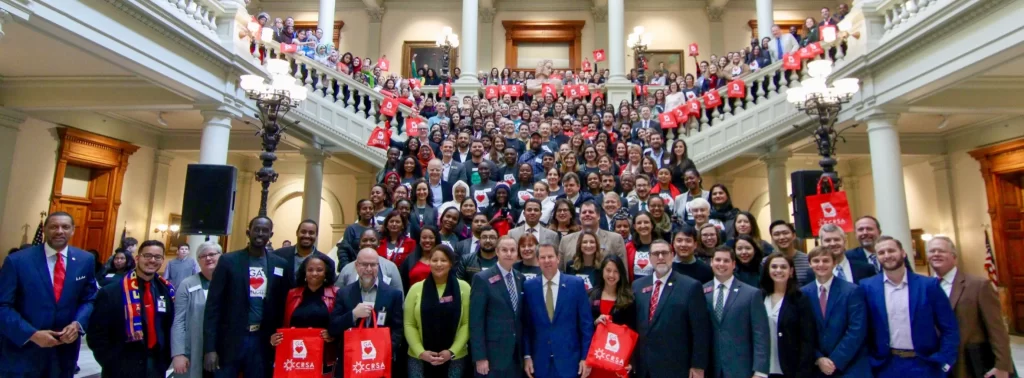
GOP Gov. Brian Kemp (center) at the CRSA “New Americans” celebration event in the GA Capitol, Feb, 2023

Updated, April 10, 2023. The below story is directly related to this: “US refugee orgs met with racism, sexism, verbal abuse from some (SIV) Afghan evacuees: IG report” – here.

SB 264 (and HB 640) would allow foreign nationals who are Refugees, “Special Visa Immigrants” and recipients of “Humanitarian Parole” (see also Biden’s parole scam) to move to Georgia and immediately access instate tuition rates. Americans migrating to our state would still be required to be residents for a year before they are allowed to pay instate tuition in our public colleges. The same bill died last year as HB 932. We had hoped the House would let us see who would vote for it.

Please read Inger’s terrific column from that adventure here.

  • Related: Federal court rules the Biden parole scam was illegal. And Biden won’t appeal.

We may want SB 264 to go to the Republican-controlled Senate floor next year – in order to see who votes “yes” in an election year. It should be noted that the Republican co-sponsors of the Democrat bill don’t seem to understand it. They do seem to know the Georgia Chamber of Commerce wants it passed.

Related: For academic year 2020-2021, the average tuition & fees for Colleges in Georgia was $4,739.00 for in-state and $17,008.00 for out-of-state. Americans who relocate here would pay the higher amount in their first year of residence.

The foreigners there catagories listed above would pay the lower amount. That is a difference of $12,260.90. 

Here are the sponsors of SB 264:

1. Jackson, Kim  (D) 41st
2. Dugan, Mike (R) 30th
3. Butler, Gloria (D) 55th
4. Payne, Chuck (R) 54th
5. Hickman, Billy (R) 4th
6. Halpern, Sonya (D) 39th


The below transcript from the March 16, Senate Higher Education committee hearing on SB 264 which was dropped  heard for the fist time in committee after Crossover Day, 2023. There is a companion bill, HB 640.

Video here. See March 16, 2023

Transcript by Rev.com

  • My cost $50.00 and about 3 hours.
  • Note: The Coalition of Refugee Services (CRSA) sent out an action alert on March 20, 2023 telling their supporters to contact the senate and ask this bill be passed. You can sign up for alerts from the CRSA here.

Democrat Sen. Kim Jackson (L) SB 264 sponsor – Darlene Lynch, Coalition of Refugee Services (CRSA) & Chair of Business and Immigration for Georgia (BIG) present SB 264
Sen. Kim Jackson (L) SB 264 sponsor – Darlene Lynch, Coalition of Refugee Services(CRSA) & Chair of Business and Immigration for Georgia (BIG).


Begin bill presentation in Senate Higher Education committee:

Sen. Kim Jackson (D- bill sponsor)

Uh, and we were working off of Senate bill 264, which is LC500510.

Senate Higher Ed committee Chairman, Sen. Billy Hickman

You’re totally good.

Sen Jackson:

All right, thank you. And I- I want to begin by thanking the chairman for allowing us to have this hearing. This is, um, such an important conversation for us to begin. And so, um, as you can see from the sign that was there, uh, many people who are very much interested and invested in this issue. Um, so very briefly, what this bill does is that it allows people who are resettled here in Georgia via a special immigration status, so what we’re talking about specifically are people who served, um, and helped our military in Afghanistan. Um, people who have been, um, clearly on our side when it’s come to those wars.

They’ve come here with special immigrant status and this bill would allow them to receive in-state tuition, uh, upon being resettled here. I think it’s important to note that none of those folks that have come here have come from another state. They don’t have another state where they could get in-state tuition, right? Oftentimes, this is what we’re thinking about. We’re like, “Oh, we don’t want somebody who lives in South Carolina, say, um, where they could get in-state South Carolina tuition, we don’t want them coming to Georgia and getting our in-state tuition.”

For people who come here who are resettled by our federal government, folks who have been our friends, who have gone through extreme amounts of trauma and yet still been dedicated to, uh, this country, people who are resettled here, this is their home state. This is in-state for them. And so, this bill would allow those who have a Humanitarian Parole status, a special immigrant status, to be able to continue their education and to do that in a way that’s affordable by receiving in-state tuition. If, with that, there are a lot of people who signed up. And so I- I’m happy to yield as much time, um, to them, if that would be helpful, Mr. Chairman.

Chairman Hickman:

Can I ask a, ask a quick question?

Sen. Jackson

Oh, please.

Chairman Hickman:

Um, uh, s- I think, um, maybe Senator Payne and I had a conversation about Dalton, Georgia, and, you know, the Hispanic population, adult and- and- and so forth, and the parents of refugees, but children… I guess the children are also refugees in the school system out there. And [inaudible 00:02:27] when they graduate from the school system, they don’t qualify for in-state tuition. Is- is that a part of all this?

Sen Jackson:

So actually, that’s a separate bill, um, so, and- and one certainly that I hope many of us will support in the future. Um, so, ch- the children that you’re referring to, um, often have DACA status. So, um, they are children who- who came with parents of their own- no- no accord of their own, right? These children are… these young adults, these are, these are young adults or- or children, they’re coming here, um, with legal status from day one.

Um, they, on day one, uh, not only did they come here with legal status on day one, they were picked out, right, from Afghanistan, from the countries that they were, um, and recognized and acknowledged as having either assisted the US military a- as interpreters or, um, being people who are extreme in danger of being harmed because of their, um, support to the US military. So these folks arrived on day one with legal status in our state as a special immigrant, um, whereas the folks that you’re talking about don’t have legal status.


Chairman Hickman

Ok..[inaudible 00:03:35].

Sen. Jackson:

So this bill would be very clear, very specific, um, to folks with legal status to be here in the state, and this is their home.

Chairman Hickman:

Senator Payne?

Senator Chuck Payne:

Yes. Uh, this, would this apply to, um, my question is, ’cause I- I’m in the military, I- I remember we had a gentleman that was actually, uh, from Nicaragua, and he was serving in, next to us in the first 504th Second Airborne Division. And you know, was s- and I come to realize since then that we have a lot of noncitizens that are serving in our military. And so, would this… For those who are living here, this would allow them, if they were living in Georgia and states [inaudible 00:04:21] and for, that- that would bene- that would help those to access-

Sen. Jackson

I- I’m gonna bring my specialist here. I- I don’t think that’s accurate. I have a different bill, um, f- to allow those folks to become peace officers in our state. But, um, this is Darlene Lynch. She really is my expert who can answer that question definitively.

Senator Payne:

Okay, thank you.

Chairman Hickman,

So again, tell us who you are and-

Darlene Lynch – (Coalition of refugee Services (CRSA):

Sure.

Chairman Hickman:

… then who you represent.

Darlene Lynch:

I’m Darlene Lynch, and I’m a lawyer here in Georgia, and I represent the Business and Immigration for Georgia Partnership. It’s a partnership of, um, refugee and immigrant serving agencies in the business community, um, and so to answer your question, uh, as- as Senator Jackson said, it’s not possible to become eligible after you’re here. You have to be admitted to the United States as a special immigrant visa holder. So a- an interpreter from, um-

Senator Payne:

Oh…[inaudible 00:05:15].

Darlene Lynch:

… Nicaragua would not have that, w- would- would not have that ability. They’d have to be from Afghanistan or Iraq. However, if they were a Humanitarian Parolee, um, approved before coming to Georgia, yes. They- they’d be-

Senator Payne:

Okay. So this is specifically for those in Afghanistan and Iraq?

Darlene Lynch:

And for others who have Humanitarian Parolee, other special immigrant status.

Senator Payne:

Okay. Okay.

Darlene Lynch:

But it’s not something you can-

Senator Payne:

The reason I identified that, because this was [inaudible 00:05:42] Nicaragua was our [inaudible 00:05:44] (laughs).

Darlene Lynch:

[inaudible 00:05:46].

Senator Payne:

And that is always one of those questions that… He- he fled Nicaragua in a very t- tough time and- and joined the military to serve our country.

Darlene Lynch:

Mm-hmm.

Chairman Hickman:

Senator Moore.

Senator Colton Moore:

Uh, thank you, Mr. Chairman. So I’m just trying to understand what a special immigration status is.

Sen. Jackson:

Sure.

Senator Moore:

And, um, if I, if I read it off the US Citizenship and Immigration Services Homeland Security website, it says, “Special immigrant is a noncitizen who qualifies for a green card after meeting certain criteria. So, it doesn’t say anything about assisting the US or the state of Georgia, for that matter.

Sen Moore:

Do you want to [inaudible 00:06:27]?

Darlene Lynch:

So the… We’re… this bill addresses three categories of people: refugees, I think most folks are familiar with the US refugee program that dates back from the Vietnam War, and the Un- and Georgia’s program dates back four decades. Special immigrant visa holders are… There’s three programs that the US government have set up. The oldest program, they’re all referenced in the bill, would apply to interpreters from Iraq and from, um, Afghanistan who served as interpreters and translators for certain periods of time and applied for an SIV and then came here.

The more recent programs, there’s another one for Iraqis, and the most recent one for Afghans, who had supported or acted in a trusted role with the US government. They have to get approved by the- the head of mission, um, and then they apply for an SIV, uh, uh, permit. They wait many, many years, up to three years now, to get that. And then they come. So, all three of those SIV programs are for people who supported the US military or the US mission in those countries. And then the last program is for Humanitarian Parolees.

Sen Jackson:

And just to hopefully alleviate some of your concerns, we do spell out the exact code section in the federal law. If you look in lines, uh, 19, starting line 18 through 22. So we’re not, um, we’re not talking about just special immigrants, but we do specify the exact, um, types of special immigrants that, um, Ms. Lynch just a- Attorney Council Lynch just referred to.

Senator Moore:

Okay. Yeah, I’ll certainly have to go read those. Thank you, Mr. Chairman.

Chairman Hickman:

Okay. Senator Burns?

Senator Burns:

Um, thank you, Mr. Chairman. And- and, uh, thank you to the author and to those who support the legislation. I certainly support the concept. Uh, I think, um, it’s a, it’s worthy for us to acknowledge the service of those who’ve helped our country. A few quick questions. Are other states offering similar benefits? Could you, could you, uh, could you share that and kind of give me an idea of what other states might have chosen to do?

Sen Jackson:

Yes. So, uh, there are other states. Tennessee, um, specifically, uh, Council Lynch might be able to add some more. Um, so, some of this is about clarifying the law. If you, if you look there, um, there is a sentence, um, I’ll see if I can refer to the line, where the Board of Regents is given some opportunity to determine. So if you look at, um, I think line, uh, it started on line 12. 12 through 14, um, the Board of Regents has some leeway already written into the law, and so in other states like Tennessee, um, they’ve actually chosen to interpret, um, that those who come as Humanitarian Parolees, who come with these SIVs, that they’re, that they qualify.

They didn’t necessarily… They then interpreted that and decided to have that kind of generous read already. So I know that’s one example, if, uh, Councilor Lynch can offer more.

Darlene Lynch:

Right. And so, different states are doing it different ways, but right now, there are 10 states who passed similar legislations. And some of them include Colorado, V- Virginia, Ohio, Wisconsin, Vermont, both Democrat, Republican states, and now there are five pending, including in Utah as the most recent one. Um, similar legislation to this bill.

Senator Burns:

And thank you. Uh, another followup, Mr.- Mr. Chairman? Uh, how many students do you feel would be a part of this qualifying group?

Sen Jackson:

Yeah, thank you so much for that question, and- and that’s something we’re trying to kind of get a han- handle on. And we’re not, we’re not 100% sure. But we believe it’ll be somewhere in the hundreds. So two, three-

Senator Burns:

You said we’re talking hundreds, not thousands, probably?

Sen Jackson:

We’re not talking, we’re not talking thousands at all. We’re talking somewhere in the hundreds.

Senator Burns:

All right. And then one more. I apologize, Mr. Chairman. But, uh, have you had these discussions with USG and TCSG?

Sen Jackson:

Absolutely. And those s-

Senator Burns:

And are- are they… I- I would… Their response, how do they feel about it?

Sen Jackson:

We- we’re continuing in those conversations.

Senator Burns:

[inaudible 00:10:26].

Sen jackson:

So those discussions have been ongoing. Um, this legislation, I think the fact that we’re having this conversation, this is a bipartisan piece of legislation that many of you, um, on the majority side have signed on. Um, I think will help us in that conversation.

Senator Burns:

Yeah, yeah, it w- it would impact their tuition, but, uh, I recognize that, uh, um, the- they just need to be a part of the conversation. That’s all I ask.

Sen Jackson:

And- and they are. They absolutely are. Would you like to answer that?

Darlene Lynch:

No, [inaudible 00:10:51].

Sen Jackson:

Okay.

Senator Burns:

Thank you, Mr. Chairman.

Chairman Hickman:

Okay. Why- why don’t we bring the company speakers so that they would… Let them have about a minute and a half each.

Sen Jackson:

Excellent.

Chairman Hickman:

And so I’ll- I’ll let you choose.

Sen Jackson:

Um, do you have the list?

Chairman Hickman:

I do.

Sen Jackson:

Actually, I’ve got another list. Do you wanna pick?

Darlene Lynch:

Um, sure.

Sen Jackson:

Which, who’s gonna speak? I think if we have Yonas come first?

Darlene Lynch:

Yes. [inaudible 00:11:13].

Sen Jackson:

Yeah, did you want to testify? (laughs).

Darlene Lynch:

[inaudible 00:11:14].

Sen Jackson:

Well, we’ll begin with Darlene, and then we’ll have Yonas speak.

Darlene Lynch:

[inaudible 00:11:18].

Sen Jackson:

Where do you want them to testify from, Mr. Chairman?

Chairman Hickman:

Yeah?

Sen Jackson:

Where- where would you like… Do you want them to do it from here?

Chairman Hickman:

Oh, sure, right there. Yeah. Go ahead.

Sen Jackson:

Yeah? Yeah. Okay. I’ll switch with you (laughs).

Darlene Lynch:

Um, thank you all, and, uh, for the opportunity to share our support for this bill. Um, and thank you for the sponsors of this bill on this committee. Again, my name’s Darlene Lynch, chair of the Business and Immigration for Georgia Partnership. I want to, um, start by saying this bill arose out of months of work on the House side of a bipartisan study committee on how to maximize Georgia’s global talent. And what we recognized is that one in 10 Georgians is foreign born today. One-tenth of our population. Um, one-seventh of our workforce is foreign born. And yet we have so much talent that we have yet to tape.

And so the Global Talent Study Committee, um, looked at what are the barriers? How can remove the, we remove those barriers? And the number one recommendation was to address the barriers to admission to Georgia public colleges. That was the number one recommendation for really strengthening our workforce. Um, and every member of that committee, both Republicans and Democrats, sponsored the- the bill, the version of the, of the bill you have before you today in the House last year. And that was HB932.

So today, we continue the work, and we have a companion bipartisan bill in the House as well. And that bill is sponsored by Sen- uh, Representative Holcomb and Hitchens, both US veterans. Um, so there’s a lot of support for this bill, um, we’ve been doing a lot of education around this bill. And as I said, it’s part of a national effort to recognize the support that people from other countries have given to our country overseas. I just wanna, uh, clarify a little bit about Georgia’s history, uh, in this, uh, regard. Georgia has a-

Chairman Hickman:

30 seconds.

Darlene Lynch:

Okay. Proud history dating back four decades of welcoming refugees. Um, they’re vetted, screened, and approved by the US, and then resettled with the state of Georgia’s help. We have a state refugee program. And so we resettle a few thousand people every year, including many children and youth who had their education, um, disrupted. The bill makes a very small change, um, as we said, um, to ensure that they are treated as in-state students as soon as they are resettled here, because they have no other state, uh, to go. I’ll end by saying this bill addresses several challenges at once.

Chairman Hickman:

Yes, ma’am. Thank you. That- that’s it. I’m sorry.

Darlene Lynch:

[inaudible 00:13:58]. Okay (laughs). Thank you.

Chairman Hickman:

Sorry. Um, we are short on time…[inaudible 00:14:05]…

Sen Jackson:

Yeah. Um, Yonas, if you could [inaudible 00:14:05].

Chairman Hickman:

Thank you, ma’am. I appreciate that. Give us your name and what you do.

Yonas Abraha:

Yes, sir. Thank you, Mr. Chairman, Senator Kim-

Chairman Hickman:

Mm-hmm.

Yonas Abraha – Coalition of Refugee Services (CRSA):

… and Senators, thank you. My name is Yonas Abraha. I am the co-chair for CRSA, which is the Coalition of Refugee, uh, Resettlement, uh, Service Agencies. So CRSA helps the refugee when they arrive here, and the coalition has about 23, uh, different organizations. And before that, if you allow me, I was just sitting here thinking if this would be an opportunity where I come from, I would not have been refugee. So thank you for that. Because most of us end up refugees, leaving our school, our family, everything behind, because of this opportunity democracy offers. So for that, thank you.

So, um, our organization, our coalition supports this bill. The reason we support this bill is as soon as, um, some of the a- agencies receive, they welcome the refugees when they arrive here at the Atlanta Airport. That’s the first airport that they come. Once they come to the airport, the first thing they ask is if they left their school, uh, “I wanna continue my education. I wanna continue my education,” because by doing that is the way for them to give back to the country that has given them opportunity.

And for us to tell them, “Hey, you c- you can’t, you can’t afford it because y- you are considered out of state,” it’s very difficult to explain that, because this is the only state that they have. And a lot of them, they have, s- especially like the Afghanis and now the U- the Ukrainians, they have left s- like, they have certification that they need in order to continue with their career. So for all that reasons, we say this is a fair bill. This is a necessary bill that we needed, because Georgia is one of the best state. I came as a refugee. I’m a [inaudible 00:16:04] refugee.

I came here, went to Cross Hill High School. I went to West Georgia. I went under my undergrad. I like it so much there, I got my master’s from West Georgia. I was even thinking about becoming a professional student, which was not possible, but I like [inaudible 00:16:18]. So, for that, most of Georgians, you know, they help us. For me, for those from my school, for my teachers, all those things I would not have gotten. So we, as the coalition, we are asking for this bill as soon as possible, if it’s possible. Thank you.

Chairman Hickman:

Yes, sir. Thank you. Senator Jackson, one- one more person.

Sen Jackson:

[inaudible 00:16:38]. Just one?

Chairman Hickman:

Yeah. We- we’re running out of time.

Sen Jackson:

[inaudible 00:16:45].

Chairman Hickman:

It’s a great- great presentation. We appreciate them.

Sen Jackson:

[inaudible 00:16:48] fixed here.

Chairman Hickman:

You need to listen up then.

Hassene Alacuzi:

So, thank you.

Chairman Hickman:

Yes, ma’am.

Hassene Alacuzi:

It’s honor to be here and talk about the positive [inaudible 00:17:03]-

Chairman Hickman:

You need to a little louder [inaudible 00:17:03].

Hassene Alacuzi:

… on this bill. I’m Hassene Alacuzi one of the new [inaudible 00:17:08] Afghan refugee in Georgia. I’ve been here for one year and my family relocated here after the Taliban take over the country. Most of my family members are here and we are all excited and motivated to track our career back here. And also we are excited that what the youth provide for us, especially for me as a woman from Afghanistan. Before the Taliban seized in Afghanistan, the number of children out of the school were 3.7. When the Taliban seized in Afghanistan, the Taliban banned women from education.

So the number moved to 6.2 million peoples or children. Today, Afghanistan is the only country that forbidden half of its population from education, which are girls and women. So, the new [inaudible 00:17:59] Afghan and the USA are the only hope of my country. I’m optimistic that one day they leave the country, they break the chain of human right violation, and this inequality of mine, in my country. However, beginning a new life in USA is not easy. We face many challenges.

Since coming to USA or to Georgia, I have been looking for opportunities to obtain my master’s degree in public health in Georgia, and also to support my family financially at the same time. But I couldn’t make this in Georgia. So I didn’t give up. And I lo- I have been, I began looking for opportunities in other state. Uh, happily I made it, and now I’m awarded the prestigious, uh, scholarship of Peter Salama with the School of Johns Hopkins, uh, School of Public Health. And, uh, so, I’m leaving Georgia, but I’m optimistic one day I can be productive to the economy of this country.

Chairman Hickman:

[inaudible 00:19:05].

Hassene Alacuzi:

My second homeland [inaudible 00:19:07].

Chairman Hickman:

Thank you, ma’am. Great. Thank you. Thank you so very much for being here. Um, [inaudible 00:19:12]-

Senator Burns:

Just a, just a quick- quick question, please. First, uh, thank you, thank you for coming and thank you for sharing. Um, where did you, uh, what is your undergraduate work in?

Hassene Alacuzi:

So I did my under-… Ah, yes. I did my undergrad in [inaudible 00:19:23] B- Bachelor of Public Health.

Senator Burns:

Very good.

Hassene Alacuzi:

And then I start working with Minister of Public Health of Afghanistan and then I continue my career with UNICEF or United National Children Emergency Fund as a nutrition officer. And I work with the, uh, Nutrition Emergency and Development program for around five years.

Senator Burns:

Thank you. And- and- and currently, are you employed? Do you have the opportunity to work?

Hassene Alacuzi:

Yes. I’m working as an interpreter with the Department of Public Health of Georgia.

Senator Burns:

Mm-hmm.

Hassene Alacuzi:

With the d-… Yes, thank you so much.

Senator Burns:

Thank you.

Hassene Alacuzi:

Yeah. With the DeKalb County Board of Health Refugee Program.

Senator Burns:

Thank you very much. I appreciate you.

Speaker 2:

Yeah.

Senator Burns:

Thanks for being here.

Hassene Alacuzi:

Thank you. Thank you for the [inaudible 00:20:03].

Chairman Hickman:

Thank you, Senator Burns, for the question. Let’s do one more.

Sen Jackson:

May I have one moment?

Chairman Hickman:

One more please.

Sen Jackson:

Uh, one more speaker or may I close?

Chairman Hickman:

One more, no, one more speaker.

Sen Jackson:

Yeah, oh, well, great. Um-

Chairman Hickman:

I wish we had more time. This is very interesting. But we don’t.

Sen Jackson:

No, that’s- that’s okay. Um, [inaudible 00:20:18].

Speaker 9 (*?):

[inaudible 00:20:18].

Sen Jackson:

David? Um, if David Garcia from GALEO?

Chairman Jackson:

Tell us your name and tell us your, where you come from and tell us what you’re doing now.

David Garcia:

Uh, uh, sure. Thank you for having me. I’m David Garcia. I work for an organization named GALEO Impact Fund. And we advocate for the Latino/Hispanic community throughout Georgia. I’m also a first generation US citizen, uh, Georgia resident, college graduate, and military veteran. Um, I graduated from Marietta High School and joined the Marine Corps shortly after. I served as a US embassy guard in Peru, China, and Serbia, and I also worked as a contractor for the US Department of State in Mexico, Bosnia, and Iraq.

And throughout my time in service, I had the privilege of working closely alongside many host country nationals who- who were vital to- to advancing US entrance worldwide. Uh, during my time in Iraq, I routinely worked with many young Iraqis who had committed most of their lives to supporting our efforts there, and their support, warmth, and commitment to our mission was vital to- to our success. And the same can be said for the thousands of Afghan citizens who’ve supported our efforts out there as well. Um, I currently live in Decatur, Georgia, which is very close to Clarkston, where I volunteer with many refugee serving agencies, including Clarkston Community Center, Refugee Coffee, Friends of, Friends of Refugees, and Clarkston United Methodist Church.

I’ve met many refugees and special immigrant visa holders in Clarkston who served alongside US forces in Iraq and Afghanistan. And according to the US t- according to the Atlanta History Center, uh, more than 1,500 Afghans have resettled in Georgia over the past two years. Uh, to me this bill is about supporting a group of- of people undergoing major life transitions and- and I can relate to many of the challenges that they face. Um, adjusting, uh, to life after living abroad was very difficult. Um, my first year back in the US after- after serving abroad was- was very challenging, and- and having structure is key in- in transitioning successfully.

Higher education and the opportunities that come with being a student on a college campus can- can help immensely in easing one’s transition, and I think that making higher education more accessible for a group of people who have supported our country and our foreign policies is the least that we can do. And I ask for your support in this bill.

Chairman Hickman:

Timing was just right. Thank you.

David Garcia:

Thank you.

Chairman Hickman:

Thank you for your service, sir. Appreciate it.

David Garcia:

Thank you.

Chairman Hickman:

Yes, sir. Um, we have, um, oh. Senator Hufstetler?

Senator Hufstetler:

Uh, I can do this later, but I guess I wanna make one point. Obviously it’s finance, y’all working incentives and trying to get people, trying to make the state better. The biggest problem we have in the state right now is workers. The limiting factor on our economy in Georgia is workers. And, um, these people are here legally. So I’ll stop there.

Chairman Hickman:

Thank you. Senator Oorock?

Sen Oorock:

Thank you. Uh, uh, I certainly was gonna lo- start with, um, Mr. Chairman, with the- the- the point of our workforce shortage. But number two, we’ve heard from the chancellor of our great university system about the decline in enrollment, and- and the need he states urgently in our budget hearing. So the need to step up, uh, uh, enrollment figures in our university system. And so we certainly have the slots there, uh, uh, and I think the case has been strongly made, uh, [inaudible 00:23:40] for, uh, moving ahead with this initiative. And let’s catch up with Tennessee.

Chairman Hickman:

Thank you. Uh, I think… I think Senator Williams has a statement.

Speaker 13:

No, I’m just [inaudible 00:23:57].

Chairman Hickman:

Y- you had a previous, uh, what? What number are you? Uh, what number is it?

Speaker 13:

[inaudible 00:24:02].

Chairman Hickman:

S- Senator Jackson. Thank you so much. I wish I- I could listen to this for a long time. I appreciate- appreciate your passion and I know the committee appreciates your passion on this. And thank y’all for being here. You know, we, um, let- let- let’s- let’s move it forward. And not next week, but next session, okay?

Sen Jackson:

May I make one closing statement?

Chairman Hickman:

Yes, ma’am.

Sen Jackson:

Uh, so I do wanna thank you so much for having this hearing. I wanna acknowledge that there’s a family that’s come, um, here that’s from Ukraine, um, they came to witness our democracy-

Chairman Hickman:

Oh, wow, cool.

Sen Jackson:

… to be a part of this conversation. Uh, and so, um, I- I understand we’re on a time limit. But I- I wanted to at least acknowledge their presence and, um, and I do hope that we can continue this conversation.

Chairman Hickman:

We will.

Sen Jackson:

Thank you so much.

Chairman Hickman:

Thank you. Thank y’all very much…….

End of bill intro

Filed Under: Recent Posts Achrives

Sen Mike Dugan cosponsors Democrat ‘Americans last’ tuition bill #SB264

June 11, 2023 By D.A. King

Senator Mike Dugan. Contact:121-F State Capitol
Atlanta, GA 30334
Office: (404) 656-7872
District Address
PO Box 1260
Carrollton, GA 30112
Email: (contact form)

Voters should talk back to the politicians they send to Atlanta

One of the glaring realities realized after nearly two decades as a reluctant denizen of the Gold Dome is that most voters have little idea about what really goes on there. A pending Democrat bill related to immigration and the cost of higher education with three Republican cosponsors is likely an example.

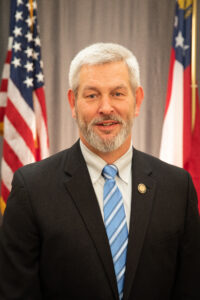
Senate Bill 264 is sponsored by Stone Mountain Democrat Sen. Kim Jackson. The number two signer on the bill is Republican Sen. Mike Dugan of Carrollton. The other two Republican cosponsors are Senators Billy Hickman (Statesboro) and Dalton’s Chuck Payne.

If passed and signed by Governor Kemp, this bill would remove the requirement now in state law that new Georgia residents must live here for a year before they can access the much lower instate tuition rate in our public colleges and technical schools.  Including the Republican cosigners, we urge all concerned to read lines 22 & 23 in the bill as introduced (LC  50 0510).            

Sen. Kim Jackson

But the proposed change would not apply to Americans.

The Democrat legislation these Republicans have decided to support only applies to foreigners with refugee and “special immigrant” status along with otherwise illegal aliens who the Biden administration moves into the U.S. as recipients of temporary “Humanitarian Parole.” Under SB 264 these lucky folks could legally “migrate” to Georgia from other countries and immediately access instate tuition rates. They would not have a twelve-month residency waiting period as do Americans.

U.S. citizens moving here from other states would still pay the much higher out of state tuition rate for their first year as a new Georgian.It’s easy and accurate to refer to this gem as an “Americans last bill.”

The measure  has been assigned to the Senate Higher Education Committee where Hickman is the chairman and saw an initial hearing on March 16, 2023. Along with Sen. Payne, with his question to the sponsor, Chairman Hickman demonstrated that that he did not understand the Democrat, immigration related bill he has cosponsored (transcript here).

How much more tuition would an American pay in our public colleges than foreign nationals?

In Carroll County, where Sen. Dugan lives, the University of West Georgia charges $2,732 (15+ hours) for instate tuition. The out of state rate is $9,641.

  • Related: Dugan’s senate email address is mike.dugan@senate.ga.gov .

According to the Georgia Southern University website, the instate tuition for undergraduates was $2732.00 for fifteen hours in the Fall 2022 semester and $9641.00 for out-of-state rate (it’s the same for Spring, and Summer 2023). Our math tells us that is a difference of $6909.00 per semester.

As per the Dalton State website, for on campus students the estimated tuition and fees per semester is $2,123.00 for instate tuition. It’s $6,334.00 for students being charged the out-of-state rate. That’s a difference of $4211.00 if my American math is correct – per semester.

Democrat Sen. Kim Jackson (L) and Darlene Lynch from Coalition of Refugee Services (CRSA) & Business and Immigration in Georgia (BIG)  present SB 264. Senate Higher Ed, committee hearing, March 16, 2023.

Based on a 9-month academic year for an average undergraduate student, tuition and fees at UGA for instate tuition is $12,080.00 The out-of-state tuition/fee cost is $31,120.00  “based on a 9-month academic year for an average undergraduate student”  (UGA website, May 30, 2023).

My guess is that cosponsoring SB 264 wasn’t at the top of any “end of session at the Gold Dome wrap up” presentation at a grassroots GOP meeting for Dugan or the other Republican cosponsors.

Pushed in the state Capitol by the leftist Coalition of Refugee Service Agencies (CRSA), Mark Zuckerburg’s little-known, pro-amnesty ‘FWD.us’ lobbying enterprise and the powerful Georgia Chamber of Commerce, the same bill (then from a Republican) died without a vote last year as HB 932. When this writer made it public during the 2022 legislative session that Speaker Pro Tem Rep Jan Jones (R – Milton) had cosponsored that bill, she went to the Clerk of the House office and scratched her name off the list of cosponsors.

  • According to their website, the CRSA mission is “to engage a broad coalition to highlight the cultural, social, and economic contributions of refugees and immigrants in Georgia.”
  • A quote on “immigration reform” on the FWD.us website goes like this: “A majority of Americans support immigration and criminal justice reform, and we’re working with legislators and groups on both sides of the aisle to drive real change at the local, state, and federal levels.” Jaime Rangel, the lobbyist in the state Capitol for FWD.us is an illegal alien.
  • The Georgia Chamber website tells us “for over 100 years the Georgia Chamber of Commerce has worked to keep, grow and create jobs to make Georgia a better state for business.”

I can sadly tell you that the list of lawmakers who have an “Americans First” mindset on business, benefits, law enforcement and educational matters when it involves immigration is short and shrinking. Voters can and should change that fact by paying attention and talking back to the politicians they elect to serve them.

There is a companion bill in the House, HB 640. Democrat Rep Scott Holcombe (Atlanta) is the lead sponsor, Republican Rep Bill Hitchens (Rincon) is the only cosponsor. Readers may want to ask their House Rep about that gem too as both bills are viable for the 2024 session. It’s an election year.

You can get more information on these bills and follow their progress at ImmigrationPoliticsGA.com.

Filed Under: Recent Posts Achrives

Sen Billy Hickman cosponsors Democrat ‘Americans last’ tuition bill #SB264

June 10, 2023 By D.A. King

Sen. Billy Hickman. Contact info: 304-A CLOB
Atlanta, GA 30334
Office: (404) 463-1371
District Address
P.O. Box 25
Statesboro, GA 30459
Office: (912) 682-5819 
Contact form for emailing Sen. Hickman

“If passed and signed by Governor Kemp, this bill would remove the requirement now in state law that new Georgia residents must live here for a year before they can access the much lower instate tuition rate in our public colleges and technical schools. But the proposed change would not apply to Americans.”

One of the glaring realities realized after nearly two decades as a reluctant denizen of the Gold Dome is that most voters have little idea about what really goes on there. A pending Democrat bill related to immigration and the cost of higher education with three Republican cosponsors is likely an example.

Senate Bill 264 is sponsored by Stone Mountain Democrat Sen. Kim Jackson. The number two signer on the bill is Republican Sen. Mike Dugan of Carrollton. The other two Republican cosponsors are Senators Billy Hickman (Statesboro) and Dalton’s Chuck Payne.

Sen. Kim Jackson

If passed and signed by Governor Kemp, this bill would remove the requirement now in state law that new Georgia residents must live here for a year before they can access the much lower instate tuition rate in our public colleges and technical schools.

But the proposed change would not apply to Americans.

The Democrat legislation these Republicans have decided to support only applies to foreigners with refugee and “special immigrant” status along with otherwise illegal aliens who the Biden administration moves into the U.S. as recipients of temporary “Humanitarian Parole.” Under SB 264 these lucky folks could legally “migrate” to Georgia from other countries and immediately access instate tuition rates. They would not have a twelve-month residency waiting period as do Americans.

U.S. citizens moving here from other states would still pay the much higher out of state tuition rate for their first year as a new Georgian.

The measure has been assigned to the Senate Higher Education Committee where Hickman is the chairman.

It’s easy and accurate to refer to this gem as an “Americans last bill.”

How much more tuition would an American pay in our public colleges than foreign nationals?

According to the Georgia Southern University website, the instate tuition for undergraduates was $2732.00 for fifteen hours in the Fall 2022 semester and $9641.00 for out-of-state rate (it’s the same for Spring, and Summer 2023). Our math tells us that is a difference of $6909.00 per semester.

  • Related: Sen Hickman’s senate email address is billy.hickman@senate.ga.gov . 

As per the Dalton State website, for on campus students the estimated tuition and fees per semester is $2,123.00 for instate tuition. It’s $6,334.00 for students being charged the out-of-state rate. That’s a difference of $4211.00 if my American math is correct – per semester.

In Carroll County, where Sen. Dugan lives, the University of West Georgia charges $2,732 (15+ hours) for instate tuition. The out of state rate is $9,641.

Democrat Sen. Kim Jackson (L) SB 264 sponsor – Darlene Lynch, Coalition of Refugee Services (CRSA) & Chair of Business and Immigration for Georgia (BIG) present SB 264 to the Senate Higher Education committee in March, 2023.

Based on a 9-month academic year for an average undergraduate student, tuition and fees at UGA for instate tuition is $12,080.00 The out-of-state tuition/fee cost is $31,120.00  “based on a 9-month academic year for an average undergraduate student”  (UGA website, May 30, 2023).

My guess is that cosponsoring SB 264 wasn’t at the top of any “end of session at the Gold Dome wrap up” presentation at a grassroots GOP meeting for Hickman or the other Republican cosponsors.

Pushed in the state Capitol by the leftist Coalition of Refugee Service Agencies (CRSA), Mark Zuckerburg’s little-known, pro-amnesty ‘FWD.us’ lobbying enterprise and the powerful Georgia Chamber of Commerce, the same bill (then from a Republican) died without a vote last year as HB 932. When this writer made it public during the 2022 legislative session that Speaker Pro Tem Rep Jan Jones (R – Milton) had cosponsored that bill, she went to the Clerk of the House office and scratched her name off the list of cosponsors.

  • According to their website, the CRSA mission is “to engage a broad coalition to highlight the cultural, social, and economic contributions of refugees and immigrants in Georgia.”
  • A quote on “immigration reform” on the FWD.us website goes like this: “A majority of Americans support immigration and criminal justice reform, and we’re working with legislators and groups on both sides of the aisle to drive real change at the local, state, and federal levels.” Jaime Rangel, the lobbyist in the state Capitol for FWD.us is an illegal alien.
  • The Georgia Chamber website tells us “for over 100 years the Georgia Chamber of Commerce has worked to keep, grow and create jobs to make Georgia a better state for business.”

I can sadly tell you that the list of lawmakers who have an “Americans First” mindset on business, benefits, law enforcement and educational matters when it involves immigration is short and shrinking. Voters can and should change that fact by paying attention and talking back to the politicians they elect to serve them.

There is a companion bill in the House, HB 640. Democrat Rep Scott Holcombe (Atlanta) is the lead sponsor, Republican Rep Bill Hitchens (Rincon) is the only cosponsor. Readers may want to ask their House Rep about that gem too as both bills are viable for the 2024 session. It’s an election year.

You can get more information on these bills and follow their progress at ImmigrationPoliticsGA.com.

Filed Under: Recent Posts Achrives

Sen Chuck Payne cosponsors Democrat ‘Americans last’ tuition bill #SB264

June 5, 2023 By D.A. King

GOP Seen. Chuck Payne. Contact info: 320-A CLOB
Atlanta, GA 30334
Office: (404) 463-5402
District Address
P.O. Box 1074
Dalton , GA 30722
Email chuck.payne@senate.ga.gov


Voters should talk back to the politicians they send to Atlanta

One of the glaring realities realized after nearly two decades as a reluctant denizen of the Gold Dome is that most voters have little idea about what really goes on there. A pending Democrat bill related to immigration and the cost of higher education with three Republican cosponsors is likely an example.

Senate Bill 264 is sponsored by Stone Mountain Democrat Sen. Kim Jackson. The number two signer on the bill is Republican Sen. Mike Dugan of Carrollton. The other two Republican cosponsors are Senators Billy Hickman (Statesboro) and Dalton’s Chuck Payne.

If passed and signed by Governor Kemp, this bill would remove the requirement now in state law that new Georgia residents must live here for a year before they can access the much lower instate tuition rate in our public colleges and technical schools.

But the proposed change would not apply to Americans.

The Democrat legislation these Republicans have decided to support only applies to foreigners with refugee and “special immigrant” status along with otherwise illegal aliens who the Biden administration moves into the U.S. as recipients of temporary “Humanitarian Parole.” Under SB 264 these lucky folks could legally “migrate” to Georgia from other countries and immediately access instate tuition rates. They would not have a twelve-month residency waiting period as do Americans.

U.S. citizens moving here from other states would still pay the much higher out of state tuition rate for their first year as a new Georgian.

The measure has been assigned to the Senate Higher Education Committee where Payne is a member and Hickman is the chairman.

It’s easy and accurate to refer to this gem as an “Americans last bill.”

How much more tuition would an American pay in our public colleges than foreign nationals? According to the Dalton State website, for on campus students the estimated tuition and fees per semester is $2,123.00 for instate tuition. It’s $6,334.00 for students being charged the out-of-state rate. That’s a difference of $4211.00 if my American math is correct – per semester.

According to the Georgia Southern University website, the instate tuition for undergraduates was $2732.00 for fifteen hours in the Fall 2022 semester and $9641.00 for out-of-state rate (it’s the same for Spring, and Summer 2023). Our math tells us that is a difference of $6909.00 per semester.

In Carroll County, where Sen. Dugan lives, the University of West Georgia charges $2,732 (15+ hours) for instate tuition. The out of state rate is $9,641.

Democrat Sen. Kim Jackson (L) SB 264 sponsor – Darlene Lynch, Coalition of Refugee Services (CRSA) & Chair of Business and Immigration for Georgia (BIG) present SB 264 to the Senate Higher Education committee in March, 2023.

Based on a 9-month academic year for an average undergraduate student, tuition and fees at UGA for instate tuition is $12,080.00 The out-of-state tuition/fee cost is $31,120.00  “based on a 9-month academic year for an average undergraduate student”  (UGA website, May 30, 2023).

My guess is that cosponsoring SB 264 wasn’t at the top of any “end of session at the Gold Dome wrap up” presentation at a grassroots GOP meeting for Payne or the other Republican cosponsors.

Pushed in the state Capitol by the leftist Coalition of Refugee Service Agencies (CRSA), Mark Zuckerburg’s little-known, pro-amnesty ‘FWD.us’ lobbying enterprise and the powerful Georgia Chamber of Commerce, the same bill (then from a Republican) died without a vote last year as HB 932. When this writer made it public during the 2022 legislative session that Speaker Pro Tem Rep Jan Jones (R – Milton) had cosponsored that bill, she went to the Clerk of the House office and scratched her name off the list of cosponsors.

  • According to their website, the CRSA mission is “to engage a broad coalition to highlight the cultural, social, and economic contributions of refugees and immigrants in Georgia.”
  • A quote on “immigration reform” on the FWD.us website goes like this: “A majority of Americans support immigration and criminal justice reform, and we’re working with legislators and groups on both sides of the aisle to drive real change at the local, state, and federal levels.” Jaime Rangel, the lobbyist in the state Capitol for FWD.us is an illegal alien.
  • The Georgia Chamber website tells us “for over 100 years the Georgia Chamber of Commerce has worked to keep, grow and create jobs to make Georgia a better state for business.”

I can sadly tell you that the list of lawmakers who have an “Americans First” mindset on business, benefits, law enforcement and educational matters when it involves immigration is short and shrinking. Voters can and should change that fact by paying attention and talking back to the politicians they elect to serve them.

There is a companion bill in the House, HB 640. Democrat Rep Scott Holcombe (Atlanta) is the lead sponsor, Republican Rep Bill Hitchens (Rincon) is the only cosponsor. Readers may want to ask their House Rep about that gem too as both bills are viable for the 2024 session. It’s an election year.

You can get more information on these bills and follow their progress at ImmigrationPoliticsGA.com.

Filed Under: Recent Posts Achrives

Illegal immigration in Georgia & SB 448 – perhaps the most, um… ‘incomplete’ bill for 2022 in the Georgia state senate #ButchMiller

February 17, 2022 By D.A. King

Sen. Butch Miller, SB 448 sponsor. Photo: Ga General Assembly

We like the concept! But SB 448 looks like a campaign bill to me. While it calls for a “citizenship status” check to determine if a “detained” and/or arrested individual is “lawfully present” in this country, it doesn’t go any further in explaining exactly how the law enforcement officer would go about that status check. Not even by saying the documents on the subject’s person should be used. I struggle not to type “poorly written.” Oops.

Maybe the sponsors could refer to this? See also 8 USC 1304

We again feel compelled to remind all concerned that “lawfully present” is a term that is not defined by congress in the INA.

The 11th circuit court of appeals of appeals weighed in on that in 2019.

But…what, exactly does the LEO do with the information if it looks like the subject is an illegal alien? Maybe nothing?

And why would we watch as yet another law like this is even discussed when OCGA 42-4-14 is ignored? 

Progress would be to actually add a written penalty to OCGA 42-4-14.

___

“SB 448  ( LC 28 0368 )

Law Enforcement Officers and Agencies; peace officer in this state who lawfully arrests an individual with or without a warrant or as the result of a traffic stop shall check such individual’s citizenship status; provide”

“First Reader Summary

A BILL to be entitled an Act to amend Chapter 1 of Title 35 of the Official Code of Georgia Annotated, relating to general provisions regarding law enforcement officers and agencies, so as to provide that each peace officer in this state who lawfully arrests or detains an individual with or without a warrant or as the result of a traffic stop shall check such individual’s citizenship status to determine if such individual is lawfully present in this country; to provide for related matters; to repeal conflicting laws; and for other purposes.
“BE IT ENACTED BY THE GENERAL ASSEMBLY OF GEORGIA:  
SECTION 1.  
Chapter 1 of Title 35 of the Official Code of Georgia Annotated, relating to general provisions regarding law enforcement officers and agencies, is amended by adding a new Code section to read as follows:  
  
“35-1-24.  
Each peace officer, as such term is defined in Code Section 35-8-2, in this state who  
lawfully arrests or detains an individual with or without a warrant or as the result of a  
traffic stop shall check such individual’s citizenship status to determine if such individual  
is lawfully present in this country.“

Sponsors

No.Number in list Name District
1. Miller, Butch 49th
2. Mullis, Jeff 53rd
3. Gooch, Steve 51st
4. McNeill, Sheila 3rd
5. Payne, Chuck 54th
6. Hickman, Billy 4th
7. Burns, Max 23rd

Filed Under: Recent Posts Achrives

Amnesty for illegals? Former state Senator Mike Dugan would not get my vote for GA03 Rep in congress

June 15, 2024 By D.A. King


Updated 5:38 PM June 15: I think I repaired the typos. I inserted a few more links to educate the reader. dak


Immigration “reform” and a “path to citizenship” would be the largest single addition to Democrat voter roles in history.

When asked about his “…priority immigration legislation for the country” if elected to congress in the June 9, 2024 GA 03 candidate debate in Atlanta, Mike Dugan replied with an immediate reference to immigration “reform.”

Q: “Senator, while you were working in the State House, you worked on several Georgia-specific ways to regulate immigration. If elected into Congress, the picture gets much bigger in what you could do. What would be your priority immigration legislation for the country?

Mike Dugan: “I think I would… It’s a two-part deal. Uh, first, before we do any immigration reform, we have to shut down the border. The- the border situation right now, it’s a- it’s a local public safety issue, it’s a humanitarian issue, it’s a national security issue. Until we shut that down with federal government working in coordination with the states, not in opposition to, we can’t really discuss immigration reform. Once it… border is shut down, then we do need to take a long, hard look at immigration reform ’cause we need new people coming into the country. We need skill sets that we had… don’t have readily available up in the numbers that we need here in- in the U.S. So that there… It’s a two-part deal, and you can’t do both of ’em at the same time.”

Audio:

https://immigrationpoliticsga.com/wp-content/uploads/2024/06/dugan-debate-9-june.m4a


A heads-up from here for trusting Republican voters voters who only read the daily headlines and get their “facts” from “the news”: On immigration, “reform” is the establishment code for amnesty. Legalization – like 1986. Make ’em legal – like 1986. Give them a work permit. It’s the mo’ money answer to illegal immigration that has been tossed out by politicians for the twenty years I have been active on immigration. Dugan’s answer is that we will “shut down” the border then we will “reform” immigration so as to create more (legal) workers and then we will import more immigrants because we need “skill sets.”

It’s amnesty and increased immigration – and “we’ll tell you when the border is ‘shut down’. Trust us.”

  • Related reading: “Immigration Reform” Equals Amnesty for Illegal Aliens and Their Employers
Mike Dugan

If voting Republicans were allowed even a shred of useful education and knowledge on the immigration reality and what happened in 1986, Dugan would likely only get votes from the business community.

This pro-enforcement advocate watched Dugan in the state Senate for the entire eleven years he was there. While not very illegal immigration vote he made was bad, many were horrible in that he went along with the “anything for a buck” agenda of the real bosses of much of Georgia state government – The Georgia Chamber of Commerce, the Metro Atlanta Chamber of Commerce, Big Ag and the lobbyists for business interests.

Perhaps the most memorable is Dugan’s support for the 2023 Democrat bill, SB 264 as second signer. That beauty was pushed by a lobbyist for the refugee industry, Darlene Lynch (she/her). Lynch boasts of her partnership with the Georgia Chamber in something they call “Business and Immigration for Georgia (“BIG”)and uses that connect to sell bills to wayward Republicans who are directed to create a larger work force quicker at any cost. (Lynch once promoted the idea of reciprocity in occupational licenses not only with other states, but other nations.)

Democrat Sen. Kim Jackson (L) and Darlene Lynch from Coalition of Refugee Services (CRSA) & Business and Immigration in Georgia (BIG) present SB 264. Senate Higher Ed, committee hearing, March 16, 2023.

SB 264 with lead sponsor Democrat Kim Jackson was dropped in the state Senate in February of 2023. When it was presented in the GOP-run Senate Higher Education Committee, it was Lynch who did most of the talking. The entire purpose of the bill was to change long standing state law on the requirement that newly arrived Georgia residents live in the state for twelve months before they can be regarded as “residents” for purposes of instate tuition at our taxpayer funded colleges and tech schools. With Dugan as the number two sponsor, the language of the bill would have allowed foreign nationals who came to the U.S. as refugees, “Special Visa Immigrants” (mostly from Iraq and Afghanistan) and recipients of the biden administration’s seemingly endless “humanitarian parole” to skip the waiting twelve month period – they would have been eligible for the huge reduction in tuition of instate tuition the day they arrived here. Americans moving here from Michigan and the rest of the nation would still be required to wait for a year before qualifying for the lower tuition rate.

I referred to SB 264, Sen. Mike Dugan cosponsor, as (yet another) “Americans last” measure.

It gets worse. When I wrote about the legislation in my regular column in Dugan’s home town newspaper, The (Carroll County) Star News, the editor gave my copy to Dugan who was able to write a rebuttal in the same edition. Point by point Dugan misrepresents the bill and even told readers it had never even seen a hearing – and that it didn’t;t matter anyway because the bill was dead because the 2023 session had ended. The fact is that I watched the hearing, and that Georgia runs on a biennial system for the legislature- the bill was quite alive for the 2024 session. I think he had Lynch write his response to me and never even checked it.

  • You can read about that bizarre response and my fact check here.

There is a lot more, but if voters liked Paul Ryan and John McCain on immigration, they should look forward to Mike Dugan going to Washington.

I know very little about Dugan’s primary runoff opponent.


Filed Under: Recent Posts Achrives

The liberal AJC vs the liberal AJC on un-American tuition bill

June 14, 2023 By D.A. King

AJC senior editors

The Atlanta Journal Constitution should run a correction

*Updated

My column posted here (and here) last week (GOP senators and another ‘Americans last’ tuition bill) concerned several Republican state senators cosponsoring a Democrat bill (SB 264) aimed at amending state law on in-state tuition. I didn’t get to the fact that the left-wing Atlanta Journal Constitution is unapologetically pushing the bill in its opinion posts with agenda-driven misinformation.

In a May 24, 2023 post AJC ‘Get Schooled’ blog writer Maureen Downey leads readers to believe that refugees are unable to access instate tuition. She introduced a guest column from an Afghan woman, Husnia Jamal, who apparently entered the U.S. as a refugee. “In a guest column, Jamal urges Georgia to embrace legislation that would allow refugees to qualify for in-state tuition. Several related measures stalled, including two bipartisan bills that would provide in-state tuition for refugees,” wrote Downey.

In that article (“Opinion: Afghan women refugees like me want a future in Georgia”) guest writer Jamal tells readers “But I, like so many other displaced people living in Georgia, found out that I could not access in-state tuition here — no matter how long I live, work, or pay state taxes — because of my immigration status. This makes it harder for us to rebuild our lives.”

“Bipartisan bills introduced in the Georgia state House and Senate this year would have changed that. The bills did not succeed” wrote Jamal.

It would nice to know exactly what visa she used to enter the U.S. but it is safe to assume that if she is not a refugee, Jamal is likely a beneficiary of the Biden administration’s humanitarian parole or is in the category of  “special immigrant.” Otherwise inadmissible aliens in that status are known as “Special Visa Immigrants”, or SIVs. * Update, Nov 20, 2023: I came across a weeper news story from the AJC on this today. Turns out the AJC news department says Jamal is here on parole. Parole does not confer lawful admission and does not confer legal status. See “What is parole” (pull down tab) here.

The reality is that state law (OCGA 20-3-66) as well as Regent’s policy (4.3.2.3) says new residents (even Afghans) must live here for a year before they can be eligible for the instate tuition rate. After that, foreign nationals with legal status – including refugees – can access the lower instate rate. Just like Americans.

  • Related: Atlanta Journal Constitution (newsroom) ethics code

Note to AJC opinion editors: That fact is reflected in at least two AJC news reports on last year’s version of the bills Downey wrote about.

“Currently, refugees must wait one year after settling in Georgia to establish residency to qualify for the lower in-state tuition rates, which are roughly three times smaller than their out-of-state counterparts” says the AJC in a Feb 24, 2022 news report (Georgia lawmakers favor tuition bill for refugee college students).

And in a one-sided January 2002 news report (Lawmakers introduce bill to help refugees attend Georgia colleges) “House Bill 932 seeks to extend in-state tuition rates to refugee students at the University System of Georgia and the Technical College System of Georgia as soon as they settle in the state. Under U.S. law, refugees are people who must relocate from their home country because of humanitarian concerns.”

The ‘Report for America’ immigration team reporter at the Atlanta paper went on with “currently they must abide by a one-year waiting period after settling in Georgia to establish residency and qualify for the lower in-state tuition rates, which are roughly three times smaller than their out-of-state counterparts” – again.

The AJC sub headline then was “legislation would help refugees qualify for more affordable in-state tuition rates as soon as they settle in the state.

As I wrote, while excluding Americans, SB 264 is written to change state law so that a list of foreigners can obtain the instate tuition rate “immediately upon settlement in Georgia.” All concerned – including state lawmakers and AJC opinion staff– should read lines 22 and 23 in the bill.

Copying senior AJC editors and the new publisher, Andrew Morse, I sent a letter for publication to the newspaper pointing out the inaccuracy in Downey’s work asking for a correction. Soon after I received a “reply all” answer from opinion editor Andre Jackson who told me that in his opinion “no correction’s warranted to the Op-Ed.”

Oh.

We think it’s worth knowing what’s really going on.

Senator Mike Dugan and SB 264

The story around SB 264 continues to expand. A version of my original IA column was later published in the Star News in exurban Carroll County which is in Republican state Senator Mike Dugan’s district (Dugan is the number two signer on the Democrat bill). The Star News editor ran a response from Dugan in the same edition that contains some remarkable inaccuracies, including his assurance to his constituents that the bill never had a hearing and is now somehow dead. The fact is that there was a hearing on SB 264 and it is very much alive under the Gold Dome for 2024. Interested readers can see a video archive of that hearing and a well-sourced fact check at ImmigrationPoliticsGA.com.

King is head of the Georgia-based Dustin Inman Society and proprietor of ImmigrationPoliticsGA.com.

A version of the above column was posted on the subscription outlet Insider Advantage Georgia on June 14, 2023

Filed Under: Recent Posts Achrives

  • Page 1
  • Page 2
  • Go to Next Page »

Primary Sidebar

 “Journalism is printing what someone else does not want printed: everything else is public relations.” Attributed to George Orwell.

miss something? see Post Archives and fast facts archives here

Categories

Brian Kemp
Photo: mdjonline.com

#BigTruckTrick

Days since GA Gov. Brian Kemp promised action on 'criminal illegals,' sanctuary cities, a criminal alien registry and related legislation:

2596

The Southern Poverty Law Center: Part Karl, Part Groucho

An Illegal Alien in Georgia Explains How To Drive Illegal Aliens Out of Georgia – SB529, 2007

https://youtu.be/oxe1WO27B_I

Gwinnett County, GA Sheriff Kebo Taylor and state law


About the author (click photo)

DA King

Foreign cops & lower college tuition for illegals than Americans, anyone? *Complete coverage of GA. House Study Committee “Innovative Ways to Maximize Global Talent”

ANSWERING THE SMEARS AJC/SPLC

Answering the smear: “blow up your buildings…” How a lie passed on by the AJC in 2007 is still being used against D.A. King (me)

FOREVER 16: REMEMBER DUSTIN INMAN

The Southern Poverty Law Center – a hate mongering scam

https://youtu.be/qNFNH0lmYdM

IMMIGRATION & WORLD POVERTY – GUMBALLS

https://youtu.be/LPjzfGChGlE?t=1

       CATO INSTITUTE: OPEN BORDERS

Georgia is home to more illegal aliens than green card holders

More illegal aliens than lawful permanent residents (green card holders) Image: GBPI.org

On illegal immigration and Georgia’s higher-ed system

Illegal aliens protest to demand "equity." Image: Twitter

Footer

Follow these immigration experts on Twitter

Follow these immigration experts on Facebook

contact georgia state legislators

State House Reps and state senators – contact georgia state legislators here.

If you don’t know who represents your and your family in Atlanta, you can find out here.

Contact the Georgia Delegation in Washington

Contact info for the Georgia delegation in Washington DC here. Just click on their name.

Copyright © 2025